Structural analysis is the engineering process of evaluating how a structure behaves under various loading and environmental conditions before it is manufactured or constructed. Selecting the right structural analysis method enables engineers to predict stresses, deformation, stability, vibration characteristics, fatigue life, and failure risks while optimizing safety, material usage, and project costs.
Different structural analysis types are designed to solve different engineering challenges. While static analysis evaluates structures subjected to constant loads, dynamic analysis studies time-dependent forces such as earthquakes and machinery vibrations. Linear and nonlinear structural analysis help engineers understand predictable versus complex material and geometric behavior, whereas finite element analysis (FEA), buckling analysis, fatigue analysis, thermal stress analysis, and seismic analysis provide deeper insight into specialized engineering problems.
In this article, we’ll explore the major types of structural analysis methods, explain when each method should be used, and highlight their applications across industrial facilities, process plants, energy infrastructure, and heavy engineering projects.
Types of Structural Analysis Methods
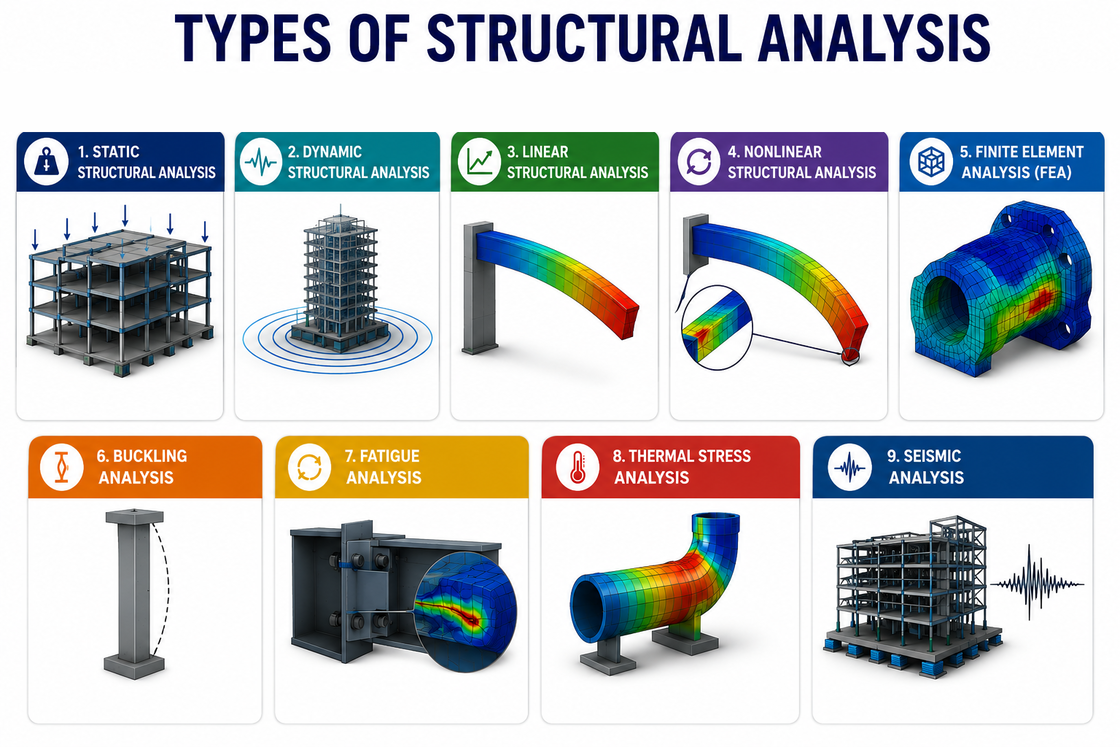
Modern engineering projects rely on different methods of structural analysis to accurately predict how structures respond under various loading and operating conditions. Selecting the right methodology depends on the nature of the loads, expected structural behavior, material characteristics, and project objectives. The table below provides a quick overview of the most used structural analysis types before exploring each in detail.
| Analysis Type | What It Evaluates | Best Used When |
| Static Structural Analysis | Structural response under constant loads | Buildings, equipment supports, platforms, process structures |
| Dynamic Structural Analysis | Structural response to time-dependent loads | Wind, vibration, machinery, impact loading |
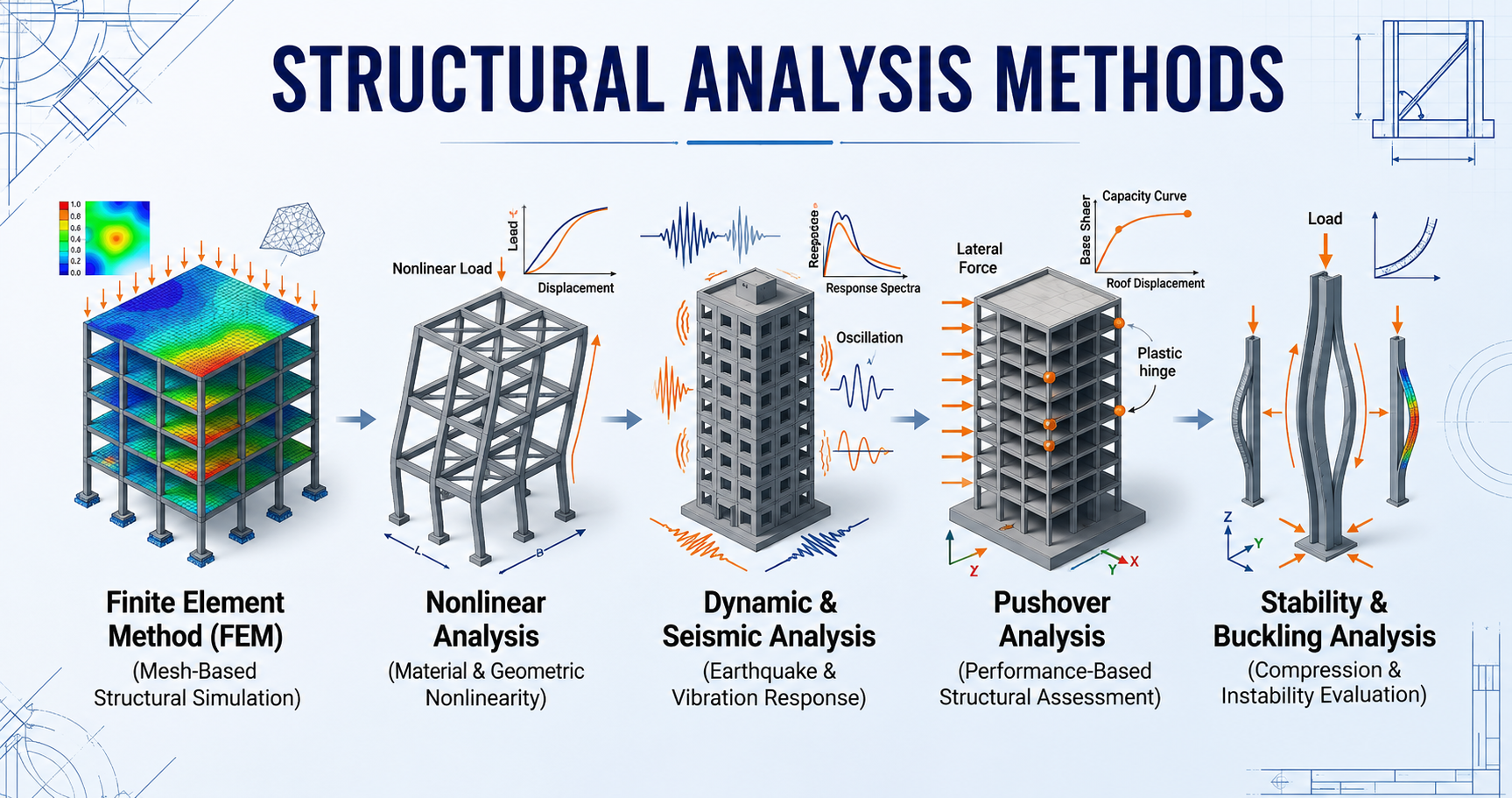
| Linear Structural Analysis | Elastic behavior with proportional load-response relationship | Small deformations and routine design conditions |
| Nonlinear Structural Analysis | Material yielding, large deformations, contact behavior | Complex industrial structures and extreme loading scenarios |
| Finite Element Analysis (FEA) | Detailed stress, strain and deformation distribution | Complex geometries and critical structural components |
| Buckling Analysis | Structural instability under compressive loads | Slender columns, stacks, storage tanks and towers |
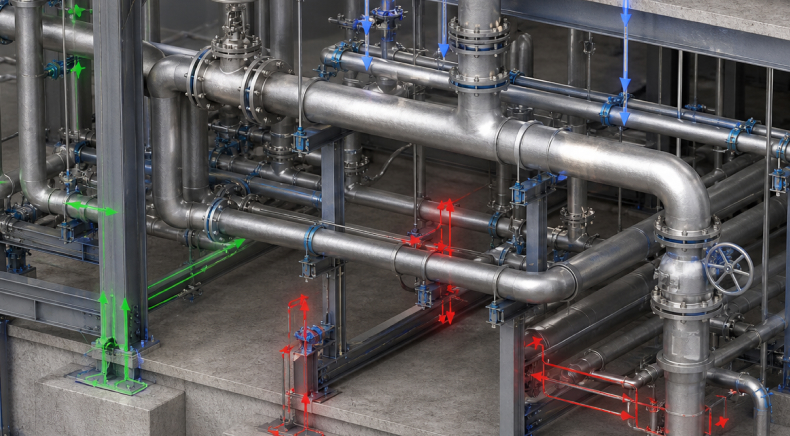
| Thermal Stress Analysis | Structural response to temperature variations | High-temperature process plants and piping systems |
| Seismic Analysis | Structural behavior during earthquakes | Facilities located in seismic regions |
Static Structural Analysis
Static structural analysis evaluates how a structure behaves under loads that remain constant or change gradually over time. These include dead loads, equipment loads, live loads, and operating loads commonly encountered in industrial facilities. It is one of the most widely used structural analysis methods during the design of buildings, steel structures, equipment foundations, platforms, and support systems where dynamic effects are minimal.
Dynamic Structural Analysis
Dynamic structural analysis evaluates structures subjected to loads that vary with time. These may include wind forces, rotating machinery, vibration, impact loads, explosions, or earthquakes. Unlike static analysis, dynamic analysis considers inertia and damping effects, allowing engineers to predict vibration characteristics, resonance, and overall structural response under fluctuating loading conditions.
Linear Structural Analysis
Linear structural analysis assumes that structural response remains directly proportional to the applied load. Materials are considered to remain within their elastic limits, while structural deformations are assumed to be small enough that they do not significantly alter the geometry. This structural analysis method is widely used during preliminary engineering, steel structure design, equipment support design, and other applications where loading conditions remain predictable and elastic behavior is expected. Linear analysis offers accurate results while requiring relatively lower computational effort.
Nonlinear Structural Analysis
Nonlinear structural analysis is used when structural behavior no longer follows a proportional relationship between load and deformation. This may occur due to material yielding, plastic deformation, geometric nonlinearity, contact interactions, or changing support conditions. Engineers commonly perform nonlinear structural analysis for offshore structures, pressure vessels, heavy industrial equipment, complex steel structures, and safety-critical facilities where realistic structural behavior must be accurately captured under extreme loading conditions.
Finite Element Analysis (FEA)
FEA divides complex structures into smaller finite elements to accurately predict stress distribution, deformation, strain, and structural performance under various loading conditions. FEA is one of the most advanced methods of structural analysis, making it particularly valuable for pressure vessels, process equipment, piping supports, industrial structures, offshore platforms, and components with complex geometries where conventional calculations may be insufficient.
Buckling Analysis
It evaluates structural stability when members are subjected to compressive forces. Instead of material failure, buckling occurs when structural elements suddenly lose stability due to excessive compression. This structural analysis type is commonly applied to slender columns, chimneys, storage tanks, transmission towers, and industrial support structures where stability is a primary design consideration.
Thermal Stress Analysis
Thermal stress analysis determines how temperature changes affect structural components through expansion, contraction, and thermal gradients. This type of structural analysis is widely used in power plants, refineries, petrochemical facilities, cryogenic systems, and process piping networks where significant temperature variations can introduce additional stresses that influence structural integrity.
Seismic Analysis
It evaluates structural performance during earthquake events by simulating ground motion and assessing how forces are distributed throughout the structure. Engineers perform seismic analysis to ensure compliance with applicable design standards while improving structural resilience and minimizing potential damage in earthquake-prone regions.
Role of Advanced Software Tools for Industrial Structural Analysis
Structural analysis is a much more sophisticated field than spreadsheets and 2D drafting. Today’s advanced technologies combine Finite Element Analysis (FEA), 3D CAD modeling, and multidisciplinary collaboration in engineering teams. These technologies increase accuracy, speed up project schedules, reduce design errors, and foster collaboration.
Let’s examine the practical use of a few of these tools:
- STAAD.Pro: STAAD is a popular tool for structural analysis and design. Engineers can assess a structure’s behavior under different loads and forces with the aid of Pro. Steel, concrete, timber, aluminum, and cold-formed structural analysis are all supported, and it conforms with international norms such as Eurocodes, IS, and AISC.
- Tekla Structures: Tekla allows for precise 3D representations of even the most intricate constructions and is mostly used for steel details and modeling. For steel buildings, skids, pipe racks, and modular structures that need accuracy and collaboration with fabrication teams, it is perfect.
- SOLIDWORKS Simulation: Integrated FEA tools for static, dynamic, thermal, and fatigue analysis allow SOLIDWORKS to expand its 3D CAD capabilities. It is especially useful for evaluating mechanical components at the part and assembly levels, allowing for iterative design modifications and verification prior to production.
- ANSYS: Exceeding linear computations, ANSYS provides FEA capabilities for comprehensive stress analysis and simulation. In load-bearing structures and important equipment supports, it aids in the analysis of fatigue, buckling, and thermal stress.
Choosing the Right Structural Analysis Method
Different structural analysis types address different engineering objectives. In many industrial projects, engineers perform multiple analyses together to obtain a complete understanding of structural behavior.
| Engineering Scenario | Recommended Analysis |
| Building under gravity loads | Static Analysis |
| Earthquake-resistant design | Dynamic + Seismic Analysis |
| Machine foundation vibration | Dynamic Analysis |
| Pressure vessel stress | Finite Element Analysis |
| Tall compression members | Buckling Analysis |
| Repeated operating loads | Fatigue Analysis |
| High-temperature process equipment | Thermal Stress Analysis |
| Complex plastic deformation | Nonlinear Structural Analysis |
Rishabh Pro Engineering’s Approach To Industrial Structural Analysis
As a multidisciplinary design engineering company, we combine deep technical expertise with leading software tools to provide end-to-end structural engineering services.
Here’s how we do it:
Expert Team & Proven Workflow
Our structural engineering team includes highly experienced engineers who work closely with process, piping, and electrical disciplines to deliver integrated designs. Every project follows a rigorous workflow:
- Requirement gathering
- Preliminary design and modeling
- Load definition and analysis
- Optimization and validation
- Documentation and client review
Software Proficiency
We use a comprehensive suite of tools including STAAD.Pro, Tekla Structures, Navisworks Manage, AutoCAD, and Revit. This allows us to model, simulate, and validate designs with confidence.
Scope of Services
Our structural engineering capabilities cover:
- Pipe racks and pipe bridges
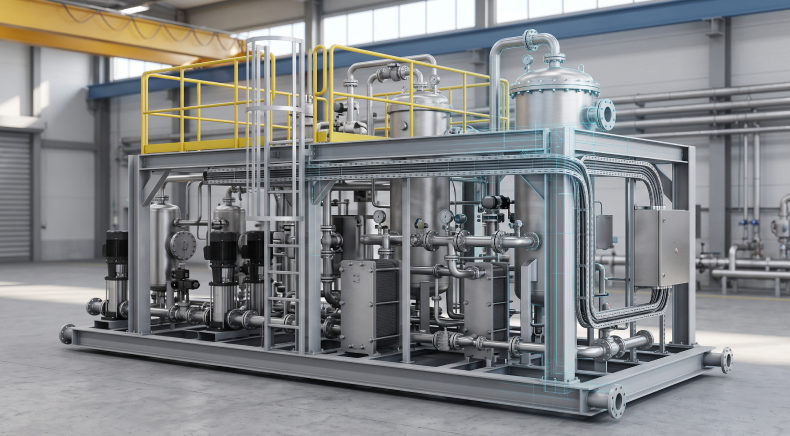
- Equipment foundations and skid structure design
- Modular platform structures
- Cold box supporting structures
- Stair towers and handrails
- Structural steel framing
- Environmental load analysis (wind, seismic, snow, transport)
We also provide foundation load tables and coordinate closely with geotechnical and civil teams.
Global Code Compliance
We deliver designs that comply with a wide range of international standards, including:
- American codes: AISC, ASCE, IBC, API
- Indian codes: IS 800, IS 456, IS 1893
- European codes: Eurocode 3 and 4
- Others based on project location and client requirements
Real-World Case Study
Let’s look at how Rishabh Pro Engineering has helped clients solve complex structural challenges using advanced modeling tools.
Case Study: Cold Box Base Plate Design
Client Overview
A global technology-driven manufacturer required structural design validation for the base plate of a cold box unit used in a cryogenic gas application. Given the critical operational environment and the need for precise load handling, they turned to Rishabh Pro Engineering for expert analysis and base plate design support for cold box structure.
Project Objective
To ensure the structural integrity and stability of the cold box base plate under multiple loading conditions, including:
- Equipment weight
- Wind load
- Seismic impact
- Transportation-induced stresses
Rishabh Pro Engineering’s Scope of Work
- 3D modeling of the base plate using Tekla
- Static structural analysis and design using STAAD.Pro Connect Edition
- Buckling and fatigue risk evaluation
- Optimization of support and anchor points
- Foundation load calculation and plate thickness validation
Analysis & Findings:
Rishabh Pro Engineering’s structural team performed a comprehensive static and dynamic analysis of the base plate structure. Through iterative finite element simulations, they validated that the proposed design could withstand the operational and transit loads without any signs of local buckling or fatigue failure.
By examining stress concentration points and ensuring an even distribution of loads, our team proposed modifications to the thickness and layout of stiffeners on the base plate. The design met both American and international structural codes, ensuring safety and compliance.
Outcome:
- Structural integrity validated under design loads
- Material savings through optimized stiffener layout
- Improved reliability during transportation and operation
- Successful compliance with client specifications and regulatory standards
Concluding Thoughts
To sum up, constructing safe, effective, and durable structures for a variety of sectors requires an awareness of the several types of structural analysis. From simple static analysis to intricate dynamic and nonlinear assessments, every technique is essential to guarantee performance in a variety of scenarios. Companies utilize advanced technologies and engineering expertise to achieve design accuracy, reduce risks, and enhance project performance. We offer specialized structural analysis services that make use of multidisciplinary skills to guarantee complete compliance with pertinent codes. In addition to improving a structure’s strength and dependability, our method encourages cost effectiveness and functional performance in a variety of engineering applications.
Frequently Asked Questions On Types Of Structural Analysis Methods
Q: What is the most common type of structural analysis?
A: Static structural analysis is the most commonly used structural analysis method because it evaluates how structures respond to constant loads such as self-weight, equipment loads, and operational loads. It is widely used for designing industrial buildings, equipment supports, platforms, and steel structures.
Q: What is the difference between static and dynamic structural analysis?
A: Static structural analysis evaluates structures under constant or gradually applied loads, whereas dynamic structural analysis considers loads that change with time, including wind, machinery vibration, earthquakes, and impact forces. Dynamic analysis accounts for inertia and damping effects that are not considered in static analysis.
Q: When is finite element analysis used in structural engineering?
A: Finite Element Analysis (FEA) is used when engineers need detailed stress, strain, and deformation results for complex geometries, localized loading conditions, pressure vessels, offshore structures, heavy equipment, and other critical industrial components.
Q: What is the difference between linear and nonlinear structural analysis?
A: Linear structural analysis assumes elastic material behavior and small deformations, where structural response remains proportional to applied loads. Nonlinear structural analysis considers material yielding, large deformations, contact behavior, and changing structural stiffness, making it suitable for more complex engineering scenarios.
Q: Which structural analysis method is used for seismic design?
A: Seismic design primarily relies on dynamic structural analysis because earthquake loads vary continuously over time. Depending on project complexity, engineers may use response spectrum analysis, time-history analysis, or nonlinear dynamic analysis to accurately predict structural performance during seismic events.