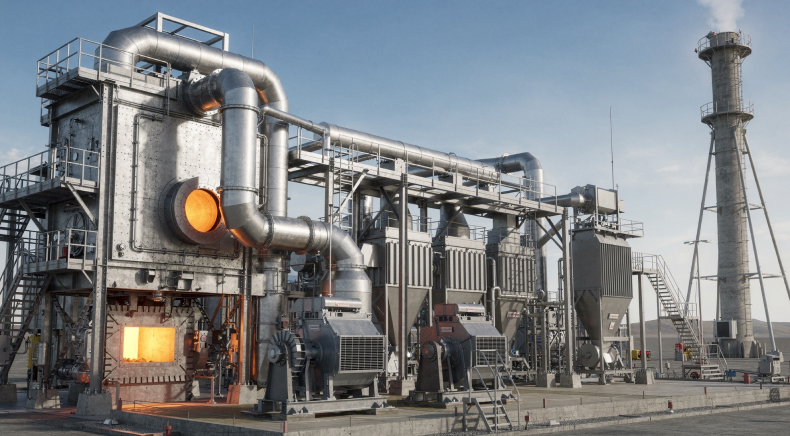
Non-ferrous metal processing plants, including copper, zinc, lead, nickel, and precious metal smelters depend on integrated furnace and off-gas systems to ensure efficient recovery, operational safety, and environmental compliance. These systems operate under extreme temperatures, abrasive particulate loading, corrosive gases, and continuous process conditions, demanding precise engineering across multiple disciplines.
Rather than functioning as standalone equipment, each process unit forms part of a connected process train. From the primary furnace to the final exhaust stack, mechanical equipment, structural steel, ducting, piping, and fabrication details must work together seamlessly to ensure reliable plant operation.
In one such project for a North American EPC/EPCM company, Rishabh Pro Engineering delivered fabrication engineering packages for five interconnected process units, transforming approved process designs and 3D models into coordinated, fabrication-ready documentation that supported efficient manufacturing and site erection.
Let’s explore these five critical units and the engineering considerations behind each.
Processing Furnace
This Processing Furnace serves as the primary thermal processing unit where roasting or smelting operations occur. It is designed to withstand sustained high temperatures while providing the controlled environment necessary for separating valuable metals from raw feed material. Because it forms the starting point of the process train, its dimensional accuracy directly impacts downstream equipment alignment.
Engineering Considerations
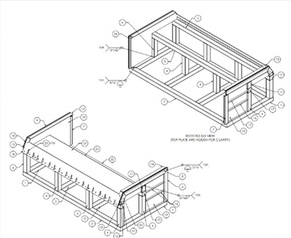 Engineering a processing furnace requires careful consideration of:
- Heavy plate fabrication
- Refractory-lined shell construction
- Structural steel supports
- Nozzle and manway layouts
- Thermal expansion allowances
- Fabrication weld sequencing
- Shop assembly methodology
Even minor dimensional deviations can create alignment issues during fabrication and erection.
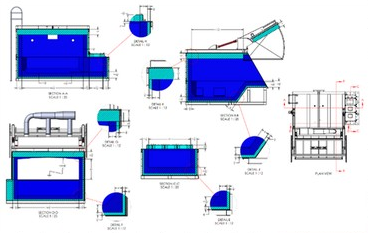 How Rishabh Pro Engineering Contributed
For this project, Rishabh Pro Engineering developed fabrication-ready shell, plate-development, structural support, and nozzle detailing drawings directly from the client’s 3D models. The multidisciplinary team ensured coordinated fabrication documentation that incorporated structural support interfaces and thermal movement considerations, enabling efficient shop fabrication and field assembly.
Vaporizing Furnace
The Vaporizing Furnace performs secondary thermal processing by maintaining process gas temperatures before the gases enter downstream treatment systems. It also serves as a critical interface between the primary furnace and particulate separation equipment.
Engineering Considerations
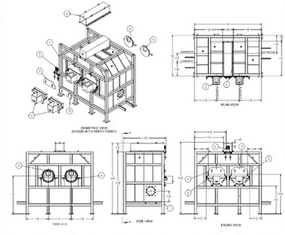 Successful engineering requires coordination between:
- Furnace shell fabrication
- Duct interfaces
- Expansion joints
- Structural framing
- Sliding supports
- Thermal expansion
- Equipment alignment
Because the equipment connects multiple process units, interface accuracy is essential.
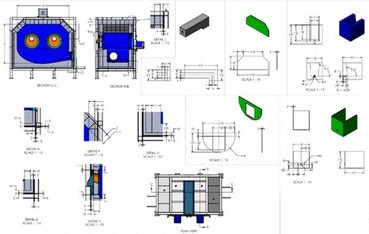 How Rishabh Pro Engineering Contributed
Rishabh Pro Engineering team prepared fabrication and assembly drawings covering furnace shell components, support steel, duct connections, and interface details. By coordinating structural, mechanical, and piping inputs within a unified drawing package, the team helped ensure accurate equipment alignment throughout the fabrication and installation process.
Hygiene Baghouse Filter & Associated Piping
The hygiene baghouse filter captures fine particulate matter from the process gas before discharge or further treatment, making it one of the plant’s most important environmental control systems.
Its associated compressed-air cleaning network, hopper discharge piping, and support steel must function as an integrated system.
Engineering Considerations
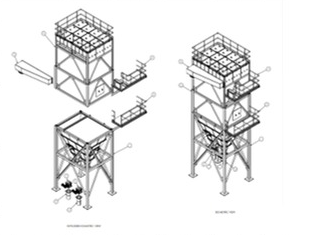 Engineering activities typically include:
- Filter housing fabrication
- Structural steel detailing
- Compressed-air piping
- Hopper discharge piping
- Pipe support design
- Access platforms
- Maintenance clearances
- Multidiscipline clash coordination
The high density of equipment often makes this one of the most complex fabrication packages in the plant.
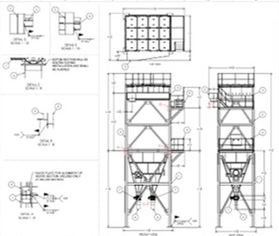
How Rishabh Pro Engineering Contributed
For the baghouse package, Rishabh Pro Engineering developed coordinated fabrication drawings for the housing, piping systems, structural steel, pipe supports, and associated spool drawings. Working from the client’s 3D models, the engineering team ensured that mechanical, piping, and structural elements were integrated into constructible fabrication packages, reducing the likelihood of fabrication conflicts and site modifications.
Exhaust Stack & Blower Inlet Duct
Following particulate removal, treated process gases are conveyed through blower inlet ducting before being safely discharged through the exhaust stack. Together, these components maintain process draft while ensuring environmentally compliant emissions.
Engineering Considerations
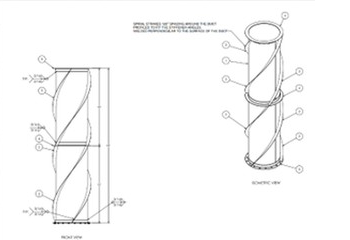 Engineering must address:
- Wind loading
- Structural stability
- Base plate design
- Anchor bolt layouts
- Reinforcement detailing
- Vacuum loading
- Thermal movement
- Fabrication plate development
These structures must remain stable under varying environmental and operating conditions.
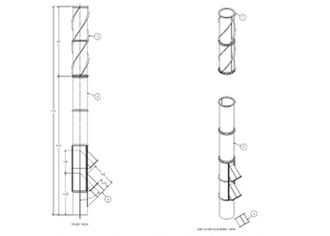 How Rishabh Pro Engineering Contributed
Rishabh Pro Engineering prepared fabrication drawings for the exhaust stack shell, support structures, base plates, anchor bolt arrangements, blower inlet duct reinforcement, and stiffener layouts. Close coordination between mechanical and structural disciplines ensured that fabrication documentation accurately reflected the equipment’s structural and operational requirements.
Grit Catcher
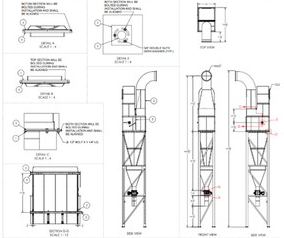
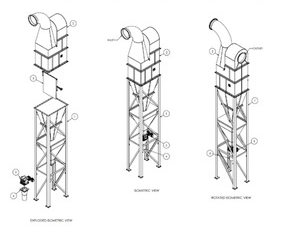
The grit catcher removes coarse particulate matter before the gas enters the baghouse, protecting downstream filtration equipment and improving overall system efficiency. Its internal geometry directly influences particle separation performance.
Engineering Considerations
 Engineering typically focuses on:
- Vessel shell fabrication
- Internal baffle arrangement
- Hopper detailing
- Nozzle orientation
- Structural support
- Inspection access
- Fabrication tolerances
Maintaining dimensional accuracy is essential for achieving the intended gas flow characteristics.
How Rishabh Pro Engineering Contributed
For the grit catcher, Rishabh Pro Engineering delivered fabrication drawings covering vessel shells, heads, internal baffles, hopper arrangements, nozzle layouts, and structural interfaces. Cross-disciplinary coordination ensured that the fabricated equipment aligned correctly with adjacent process units while supporting efficient shop manufacturing and field installation. This approach helped translate detailed engineering requirements into fabrication-ready deliverables, as demonstrated in the project case study below.
Bringing the Entire System Together
While each process unit performs a distinct function, the overall success of a furnace and off-gas handling system depends on seamless integration across mechanical, structural, and piping disciplines.
For this project, Rishabh Pro Engineering delivered a coordinated fabrication engineering package comprising General Arrangement (GA) drawings, fabrication drawings, piping isometrics, spool drawings, structural detailing, Bills of Materials (BOM), Material Take-Offs (MTO), weld maps, interface drawings, and Issued-for-Construction (IFC) documentation. Developed using Autodesk Inventor, Tekla Structures, SOLIDWORKS, and AutoCAD, these deliverables enabled the client to progress from design models to fabrication-ready documentation within an accelerated project schedule.
Concluding Thoughts
Non-ferrous metal processing facilities demand more than robust process equipment—they require engineering that seamlessly integrates furnaces, gas-handling systems, structural frameworks, and piping networks into a constructible, fabrication-ready solution.
Whether developing a processing furnace, engineering a baghouse filtration system, detailing an exhaust stack, or coordinating interconnected process units, multidisciplinary collaboration is essential to minimizing fabrication risks and ensuring reliable plant performance. Through this project, Rishabh Pro Engineering demonstrated how our 2D CAD drafting services can transform complex process designs into coordinated, fabrication-ready documentation, supporting efficient manufacturing, streamlined installation, and successful project execution.