In industrial projects, one of the most common, and costly misconceptions is this:
3D laser scanning is seen as a standalone cost.
It’s not.
Treating it that way leads to poor vendor selection, under-scope engineering, and eventually rework, clashes, and delays during execution.
The reality is that 3D laser scanning is only one part of a much larger value chain. The real 3D scanning services cost and more importantly, the real value lies in how that data is processed, modeled, and integrated into engineering workflows.
This is where most stakeholders get it wrong.
Two vendors may quote drastically different numbers for what appears to be the same scope. On paper, both include “3D scanning.” But in practice, one may be delivering raw point clouds, while the other is delivering engineering-ready models that can be used for design, coordination, and construction. If you’re comparing them purely with 3D scanning services price, you’re not making a cost decision you’re making a risk decision.
A Typical 3D Scanning Services Price Distribution
Instead of looking at 3D scanning as a flat service cost, it’s far more accurate to view it as a percentage distribution across the engineering lifecycle.
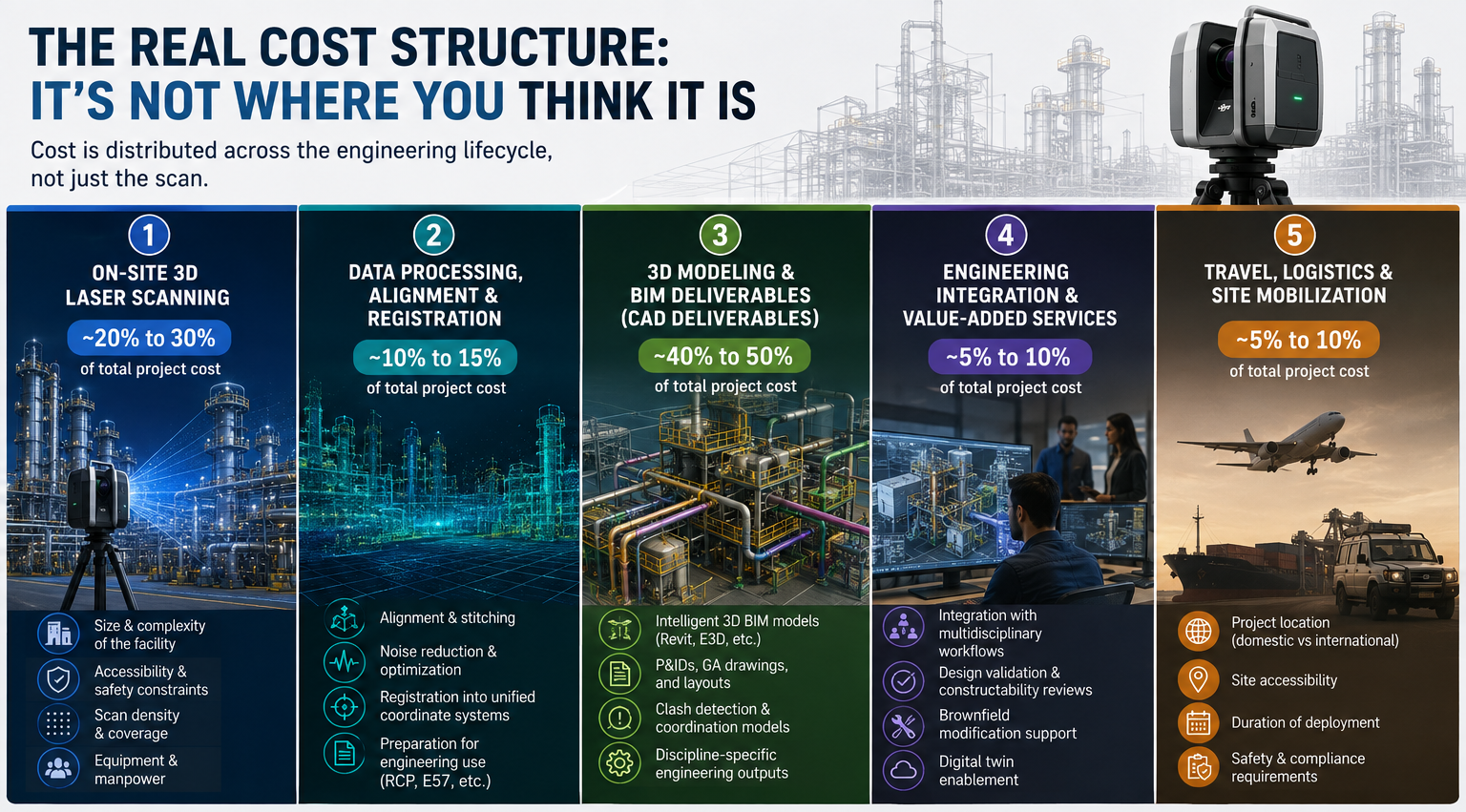
On-Site 3D Laser Scanning
~20% to 30% of total project cost
This phase involves capturing real-world conditions using advanced LiDAR or laser scanning equipment. The 3D scanning cost depends on:
- Size and complexity of the facility
- Accessibility and safety constraints
- Required scan density and coverage
- Type of equipment and manpower deployed
But here’s the reality:
Scanning is just data capture. Not value creation.
In complex environments like process plants, refineries, or FPSOs, the challenge isn’t capturing data, it’s making that data usable.
And that’s where the real 3D scanning services cost begins.
Data Processing, Alignment & Registration
~10% to 15% of total project cost
Once scanning is complete, raw point cloud data undergoes:
- Alignment and stitching
- Noise reduction and optimization
- Registration into unified coordinate systems
- Preparation for engineering use (formats like RCP, E57, etc.)
This stage is often underestimated, but if it’s done poorly, everything that follows is compromised.
Misaligned data doesn’t just create minor inaccuracies, it leads to design errors, rework, and coordination failures downstream. In other words, this is where data either becomes reliable, or becomes a liability.
3D Modeling & BIM Deliverables (CAD Deliverables)
~40% to 50% of total project cost
This is typically the largest cost component in 3D scanning services, as it transforms raw scanned data into actionable engineering deliverables.
- Creation of intelligent 3D BIM models (Revit, E3D, etc.)
- Generation of P&IDs, GA drawings, and layouts
- Clash detection and coordination models
- Conversion into discipline-specific engineering outputs
Here’s the uncomfortable truth:
If your project is optimized for 3D laser scanning cost instead of modeling quality, you are setting yourself up for downstream failure.
Why?
Because scanning tells you what exists.
Modeling tells you what to do with it.
And only one of those drives project decisions.
Engineering Integration & Value-Added Services
~5% to 10% of total project cost
This is where most standalone scanning vendors stop—and where actual engineering value begins.
This includes:
- Integration with multidisciplinary engineering workflows
- Design validation and constructability reviews
- Brownfield modification support
- Digital twin enablement
At Rishabh Pro Engineering, this is not an add-on—it’s the core of the offering.
Because without integration, even the most accurate model has limited impact.
Data without engineering context is just expensive storage.
Travel, Logistics & Site Mobilization
~5% to 10% of total project cost
This is the most straightforward component, but still variable depending on:
Costs vary based on:
- Project location (domestic vs international)
- Site accessibility
- Duration of deployment
- Safety and compliance requirements
While it doesn’t directly influence engineering quality, it can significantly impact overall project cost, especially in remote or high-risk environments.
Disclaimer: The cost distribution presented is based on a representative model for typical industrial scanning-to-engineering projects and is intended for informational purposes only. Actual costs and allocation may vary based on project scope, site conditions, location, and specific project requirements. These figures do not constitute a quotation or fixed pricing structure from Rishabh Pro Engineering.
3D Scanning Services Price: A Real-World Project Estimate
To understand how the percentage-based model works in real scenarios, consider a brownfield modification project for a mid-sized process plant.
Consider a brownfield modification project for a mid-sized process plant, where the total engineering scope is valued at approximately $120,000. The requirement includes existing condition capture, 3D modeling, and integration into engineering workflows.
Here’s how the cost is typically distributed:
| Cost Component | % Allocation | Estimated Cost ($) | What You’re Actually Paying For |
| On-Site 3D Laser Scanning | 25% | 30,000 | LiDAR scanning, site capture, manpower |
| Data Processing & Registration | 12% | 14,400 | Point cloud alignment, cleaning, geo-referencing |
| 3D Modeling & BIM Deliverables | 45% | 54,000 | Intelligent models, drawings, clash detection |
| Engineering Integration | 8% | 9,600 | Design validation, coordination, constructability |
| Travel & Logistics | 10% | 12,000 | Mobilization, site access, compliance |
Disclaimer: The percentages and estimated costs shown are illustrative figures based on a representative industrial scanning-to-engineering project and are provided for informational purposes only. They do not represent actual pricing or commercial offer of any project. Actual costs may vary based on project scope, site conditions, location, technical requirements, and other project-specific factors.
What This Means in Practice
- Major cost driver = Modeling (≈45%)
Because this is where raw scan data becomes usable engineering output.
- Scanning is only ~25%
Many assume scanning is the biggest cost, it’s not. The real value lies in interpretation and engineering.
- Integration ensures ROI
The 8% spent here prevents costly rework during execution.
Scenario-Based Variation
Depending on project conditions, this distribution can shift:
- High-detail (LOD 200-400) projects where Modeling may go up to 50–55%
- Remote or hazardous locations where Scanning + logistics may increase to 30–35% combined
- Engineering-lite scope (scan-to-point cloud only) where total cost would be reduced, but downstream risk increases
Note: The above estimate reflects a cost-efficient execution model leveraging global engineering delivery. Projects executed entirely in North America or Europe may have significantly higher cost benchmarks due to labor and compliance factors.
Key Factors That Influence 3D Scanning Services Cost
Even within this percentage framework, project costs can fluctuate significantly based on the following:
Level of Detail (LOD)
Higher LOD requirements demand:
- More scan points
- Increased modeling effort
- Greater validation and detailing
Capturing fine elements (e.g., small conduits, instrumentation lines) can substantially increase both scanning and modeling effort.
Accuracy Requirements
Projects requiring high precision (e.g., tie-ins, revamps, or modular installations) may involve:
- Advanced equipment
- Additional control points
- Rigorous validation processes
Project Complexity
Brownfield environments typically involve:
- Congested layouts
- Incomplete legacy documentation
- Operational constraints
This increases both field effort and engineering time.
Scope Definition & Data Availability
Incomplete input data can lead to estimation variability. In many cases, costs may vary by up to 20–25% depending on actual site conditions and scope clarity.
Providing detailed site inputs early significantly improves cost accuracy and delivery timelines.
Why 3D Scanning Services Cost Should Be Viewed Beyond Pricing
Poor-quality scans or inaccurate models can lead to:
- Rework during engineering
- Clash issues during construction
- Delays in project execution
Instead, the focus should be on value-driven engineering outcomes, including:
- Accurate as-built documentation
- Reduced rework and site errors
- Improved multidisciplinary coordination
- Faster project turnaround
How Rishabh Pro Engineering Adds Value
Unlike standalone scanning vendors, Rishabh Pro Engineering integrates 3D scanning with full-cycle point cloud to 3D modeling services, ensuring that data is not just captured, but effectively utilized.
Our approach includes:
- Seamless transition from scan to BIM to engineering deliverables
- Multidisciplinary engineering coordination across piping, structural, electrical, and instrumentation & control
- Support for brownfield, revamp, and EPC projects
- Alignment with global standards and client-specific requirements
This ensures that every percentage of project cost contributes directly to engineering efficiency and project success.
Case Study: From 3D Laser Scanning to an Engineering-Ready Digital Twin
The Challenge
A large, operational 150+ acre multi-zone facility required a reliable digital representation of its existing infrastructure to support asset management, facility modernization, renovation and future expansion.
With multiple facility types, industrial assets, buildings and utilities across the site, conventional documentation alone was not sufficient to provide the level of visibility required for ongoing engineering decisions.
The challenge was therefore not simply to capture the facility; it was to convert captured site reality into usable engineering information.
Rishabh Pro Engineering’s Approach
Our team executed a structured scan-to-BIM workflow, transforming extensive 3D laser scan point-cloud data into coordinated, engineering-ready digital models.
The workflow included:
Point Cloud Registration → BIM Conversion → Multidisciplinary Modeling → Model Validation → Clash Detection → Intelligent Data Extraction
The scope incorporated architectural, structural and MEP elements, together with topography and site context, to develop a coordinated LOD 500 digital twin.
Engineering Deliverables
- Coordinated LOD 500 BIM model
- Architectural, structural and MEP models
- Topographical and site-context models
- Intelligent asset information and schedules
- 2D plans, sections, elevations and details
- Clash detection and coordination reports
- QA-validated digital twin models
- Facility-management-ready documentation
Key Takeaway
By combining reality capture, point-cloud processing, BIM modeling and multidisciplinary engineering capabilities, Rishabh Pro Engineering helps industrial clients move from **raw scan data to actionable engineering intelligence.
Final Perspective
Understanding 3D scanning services cost requires looking beyond the price of capturing point-cloud data. The real value comes from how accurately that data is processed, modeled, validated, and integrated into engineering workflows. By evaluating the complete scanning-to-engineering lifecycle, project teams can make better-informed decisions, reduce downstream rework, and improve coordination and execution. The right approach is not simply to minimize scanning costs, but to invest in reliable, engineering-ready data that supports better project outcomes from design through execution.
Frequently Asked Questions On 3D Scanning Cost
Q: How much do 3D scanning services typically cost?
A: The cost varies based on the project scope, facility size, site conditions, required deliverables, location, and level of detail. A project may include costs for scanning, data processing, 3D modeling, engineering integration, and logistics, so pricing is typically determined on a project-specific basis.
Q: What is included in the cost of 3D scanning services?
A: Depending on the scope, 3D scanning services cost may include site scanning, point-cloud processing and registration, 3D modeling or BIM deliverables, engineering integration, and travel or site mobilization. The exact inclusions should be clearly defined before comparing quotations.
Q: Why can quotes for 3D scanning services vary significantly between vendors?
A: Different quotations may cover different levels of service. One provider may deliver only raw point-cloud data, while another may include processed data, engineering-ready models, coordination, validation, and related engineering deliverables. Comparing the total scope, not just the scanning price, provides a more meaningful cost comparison.
Q: How can I get an accurate estimate for 3D scanning services cost?
A: An accurate estimate requires clear information about the project scope, site conditions, location, areas to be scanned, required accuracy and level of detail, expected deliverables, and intended engineering use. Providing these inputs early helps vendors develop a more reliable project-specific cost estimate.