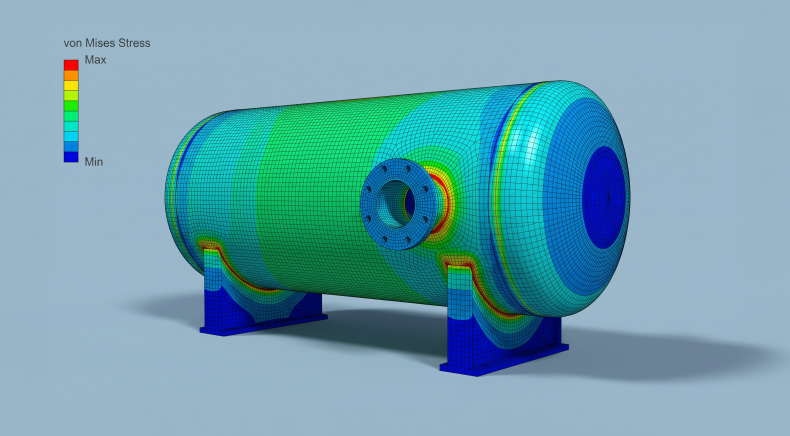
The different types of FEA (Finite Element Analysis) help engineers evaluate how components, structures, and mechanical systems respond to different operating conditions. The appropriate analysis depends on three key questions: Is the material or geometry behavior linear or nonlinear? Are the applied loads static or dynamic? Is the engineering problem structural, thermal, or a combination of both?
Understanding the types of finite element analysis helps engineering teams select suitable simulation methods, evaluate design performance, and identify potential failure conditions before manufacturing or installation. From basic structural checks to complex nonlinear and transient simulations, each finite element analysis type addresses a different engineering requirement.
In this article we’ll explore the commonly used FEA types, their classification, and how to choose the right approach for a particular engineering problem.
Types of FEA Analysis at a Glance
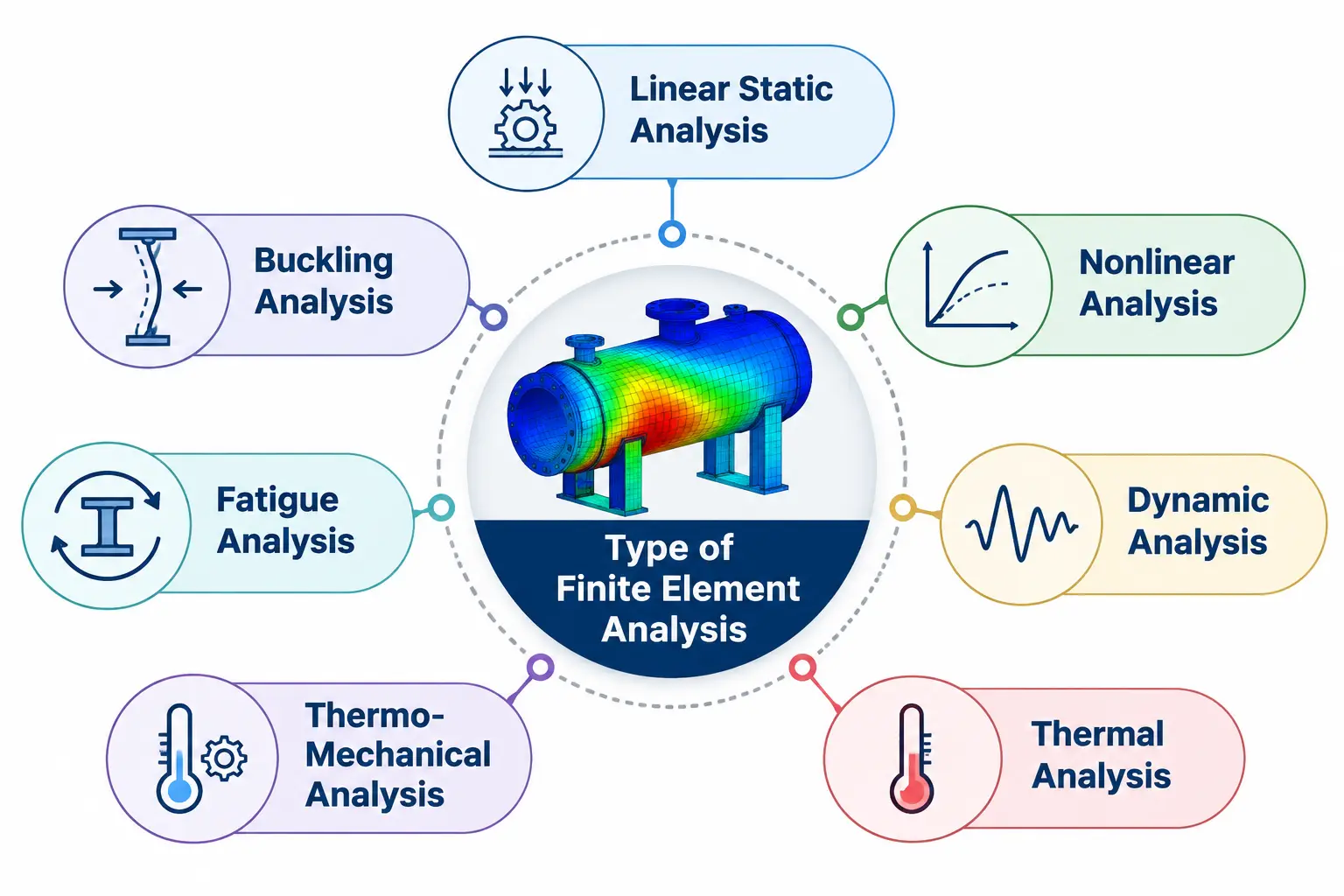
Different FEA analysis types address different physical behaviors and loading conditions. The following table provides an overview of commonly used types of FEA analysis and their typical industrial applications.
| Type of FEA | Engineering Question It Answers | Typical Industrial Application |
| Linear Static Analysis | Will the component withstand the applied loads without exceeding allowable stress or deformation? | Structural frames, equipment supports, and modular skids |
| Nonlinear Analysis | How will the component behave when material, geometry, or contact behavior becomes nonlinear? | Bolted joints, pressure equipment, and components undergoing plastic deformation |
| Dynamic Analysis | How will the structure respond to time-varying or vibration-related loads? | Rotating equipment supports, vibration-prone piping, and machinery foundations |
| Thermal Analysis | How will temperature distribution develop across a component or system? | Heat exchangers, pressure vessels, boilers, fired heaters, industrial furnaces, cooling towers |
| Thermo-Mechanical Analysis | How will temperature changes influence stress, deformation, and structural performance? | Cryogenic systems, hot equipment connections, and thermal piping systems |
| Fatigue Analysis | Can the component withstand repeated loading over its expected service life? | Pressure equipment, piping systems, and cyclically loaded structures |
| Buckling Analysis | Can the component maintain stability under compressive loading? | Columns, support structures, and slender mechanical components |
These categories may overlap. For example, a component subjected to repeated temperature changes may require a combination of transient thermal, structural, and fatigue evaluations.
How Are Finite Element Analysis Types Classified?
Finite element analysis types are classified based on the behavior being evaluated, applied loads, and physical phenomena involved. Three key considerations help determine the appropriate analysis approach.
Linear or Nonlinear Analysis
Linear analysis assumes a proportional relationship between applied loads and structural response. Nonlinear analysis accounts for material yielding, large deformations, and changing contact conditions.
Static or Dynamic Analysis
Static analysis evaluates constant or slowly varying loads where inertial effects are negligible. Dynamic analysis considers time-dependent loads, vibrations, and impacts where inertia influences structural response.
Structural, Thermal, or Coupled Analysis
Structural analysis evaluates stress, strain, deformation, and stability. Thermal analysis examines temperature distribution and heat transfer, while coupled analysis considers interactions between thermal and structural behavior.
Note: Seismic loading is a load case evaluated through appropriate structural analysis methods, while CFD is a separate simulation method for fluid flow and heat transfer.
Types of FEA Analysis Explained
The following are some of the most widely used types of finite element analysis in industrial and mechanical engineering applications.
Linear Static Analysis
Linear static analysis is often the starting point for structural simulation. It evaluates how a component or structure responds to applied loads under conditions where material behavior remains elastic and deformations are sufficiently small.
This method generally assumes:
- Material behavior follows a linear stress-strain relationship.
- Deformations are small enough that changes in geometry do not significantly affect the response.
- Loads are constant or applied gradually, with inertial effects considered negligible.
- Contact conditions, where present, remain unchanged.
Engineers use linear static analysis to evaluate stresses, strains, displacements, and support reactions. It is commonly applied to structural frames, equipment supports, baseplates, and modular skid structures. For example, an engineering team may use linear static FEA to check whether a structural skid frame can withstand the weight of installed equipment, operating loads, and other specified design loads. However, the assumptions behind linear static analysis have limitations. If the material approaches yielding, the structure undergoes significant deformation, or contact conditions change under loading, a nonlinear analysis may be necessary.
Nonlinear Analysis: Material, Geometric, and Contact Nonlinearity
Nonlinear FEA is required when the relationship between applied loads and structural response cannot be represented accurately through linear assumptions. The nonlinearity may arise from material behavior, changes in geometry, or interactions between contacting components.
The three common forms include:
Material Nonlinearity
Material nonlinearity occurs when the material no longer follows a linear elastic stress-strain relationship. For example, when a component experiences plastic yielding, its deformation may continue even after the material exceeds its elastic limit.
Engineers use elastic-plastic material models to evaluate deformation, residual stresses, and load-carrying behavior beyond initial yielding. Such evaluations may be relevant to pressure equipment assessments, including design-by-analysis checks under ASME Section VIII, Division 2, where applicable.
Geometric Nonlinearity
Geometric nonlinearity becomes important when deformation significantly changes the component’s original geometry and influences its response to loading. Large displacement, large rotation, and deformation-dependent stiffness can affect the accuracy of a linear solution. This type of analysis is useful for evaluating flexible structures, slender components, and systems where substantial deformation may occur.
Contact Nonlinearity
Contact nonlinearity occurs when interacting surfaces open, close, slide, or separate under applied loads. Contact conditions may change during the simulation, making the structural response nonlinear.
For example, flange interfaces and bolted joints may require contact analysis to evaluate separation, pressure distribution, and load transfer under operating conditions. Nonlinear analysis is particularly valuable when a design must be assessed beyond its initial elastic response or when component interactions influence structural performance.
Dynamic Analysis
Dynamic analysis evaluates how structures and mechanical systems respond to loads that vary with time. Unlike static analysis, it accounts for inertia and, depending on the method, damping and time-dependent structural behavior.
Common types of dynamic FEA include:
- Modal Analysis: Determines the natural frequencies and mode shapes of a structure. It helps identify potential resonance conditions.
- Harmonic Analysis: Evaluates the steady-state response of a structure subjected to sinusoidal or periodic excitation over a range of frequencies.
- Transient Analysis: Examines structural response to time-varying loads over a specified period.
- Shock and Impact Analysis: Evaluates the effects of sudden loading, collisions, or short-duration force events.
Dynamic simulations may use implicit or explicit solution methods, depending on the nature of the problem.
Implicit methods are commonly applied to problems involving relatively smooth loading and structural response, where the system evolves gradually over time.
Explicit methods are often suitable for short-duration events involving impact, severe contact changes, or highly nonlinear behavior, where rapid changes in structural response need to be captured.
The appropriate solver depends on the problem’s time scale, nonlinearities, and numerical requirements.
In industrial engineering, dynamic analysis may be used to assess vibration-prone piping, rotating equipment supports, machinery foundations, and structures exposed to fluctuating loads.
For example, modal analysis can help identify whether a support structure’s natural frequency is close to the operating frequency of connected rotating equipment. Further dynamic evaluation may then be required to understand the resulting response.
Thermal and Thermo-Mechanical Analysis
Thermal analysis evaluates temperature distribution within a component or structure due to applied temperatures, heat sources, and heat transfer conditions. It helps engineers understand how temperature varies across a system and over time.
Thermal analysis is generally classified into two approaches:
- Steady-State Thermal Analysis: Determines temperature distribution when thermal conditions have reached a stable state and are no longer changing with time.
- Transient Thermal Analysis: Evaluates how temperature distribution changes over time, such as during heating, cooling, or start-up and shutdown cycles.
Thermo-mechanical analysis goes a step further by evaluating how temperature changes influence structural behavior. Temperature variations can cause expansion, contraction, thermal stress, and deformation, particularly when movement is restricted by supports or connected equipment. For example, cryogenic cold boxes operate under extremely low temperatures, creating thermal contraction and differential movement that must be considered in design. Similarly, hot nozzle connections may experience thermal expansion and associated loads that influence connected equipment. Combining thermal and structural evaluations helps engineers understand the mechanical implications of operating temperature conditions and assess whether the design can accommodate the resulting stresses and movements.
Fatigue and Other Specialized Analysis
Some components experience repeated loading throughout their operating life. Even when individual load cycles do not exceed the material’s yield strength, repeated stress variations can initiate and propagate cracks over time. Fatigue analysis evaluates this behavior and helps estimate component durability under cyclic loading.
Fatigue Analysis
Fatigue evaluation considers factors such as stress range, number of loading cycles, material properties, and operating conditions. It is relevant to piping systems, pressure equipment, machinery components, and structures subjected to repeated mechanical or thermal loads. Fatigue is generally classified into two categories: high-cycle fatigue, which occurs under many cycles at relatively low stress levels, and low-cycle fatigue, which involves fewer cycles with higher stress variations and often greater material deformation. Thermal fatigue is a related concern in systems exposed to repeated heating and cooling, where temperature gradients or constrained expansion can generate recurring thermal stresses.
Buckling Analysis
Buckling analysis evaluates the stability of components subjected to compressive loads. It helps identify the risk of structural instability before material stress limits are reached, particularly in slender columns, support members, thin-walled components, and structures with insufficient stiffness.
These specialized evaluations are selected based on the component’s expected operating conditions, potential failure mechanisms, and required service life.
How to Choose the Right Type of FEA
Selecting the appropriate FEA type starts with understanding the engineering question, expected loading conditions, and physical behavior of the component or system. Linear static analysis is often a practical starting point when material behavior, deformation, and contact conditions remain within linear assumptions. More advanced types should be considered when these assumptions cannot adequately represent actual operating conditions.
| Engineering Question | Recommended FEA Type | When to Escalate | Check First |
| Does the structure withstand the specified static loads without exceeding allowable stress or deformation limits? | Linear Static Analysis | Escalate to nonlinear analysis if yielding, large deformation, or changing contact conditions are expected. | Verify applied loads, supports, boundary conditions, material properties, bolt pretension (where applicable), and mesh convergence. |
| Could the component yield or change contact state under load? | Nonlinear Analysis | Use nonlinear material, geometric, or contact analysis when plastic deformation, large displacements, or separation and sliding between components are expected. | Check material stress-strain data, contact definitions, friction coefficients, bolt pretension, and nonlinear solution convergence. |
| Could vibration, impact, or time-varying loads affect structural performance? | Dynamic Analysis | Escalate from static to dynamic analysis when inertia, resonance, transient loading, or impact effects significantly influence structural response. | Verify mass distribution, support stiffness, damping assumptions, natural frequencies, excitation frequencies, and load-time history. |
| Could operating temperature changes affect component integrity or structural performance? | Thermal or Thermo-Mechanical Analysis | Use transient thermal analysis for time-dependent temperature changes and coupled thermo-mechanical analysis when thermal expansion or temperature-dependent properties influence structural response. | Check temperature profiles, thermal boundary conditions, material thermal properties, expansion coefficients, insulation assumptions, and support constraints. |
| Could repeated or fluctuating loads initiate fatigue damage during the expected service life? | Fatigue Analysis | Escalate to fatigue assessment when cyclic stress variations, repeated operating loads, or vibration may cause progressive damage. | Verify stress ranges, load cycles, material fatigue curves, weld details, stress concentrations, and operating duty cycles. |
| Could compressive loads cause buckling or structural instability? | Buckling Analysis | Escalate from linear eigenvalue buckling to nonlinear buckling analysis when imperfections, material yielding, or post-buckling behavior may influence stability. | Check member slenderness, support conditions, initial imperfections, residual stresses, material properties, and mesh convergence. |
The objective is not to select the most complex simulation available. It is to choose a type that accurately represents the physical behavior being investigated. Engineering teams should begin with the simplest suitable analysis and introduce additional complexity when the design assumptions, loading conditions, or expected response require it.
How Rishabh Pro Engineering Supports Finite Element Analysis
At Rishabh Pro Engineering, we support EPC contractors, OEMs, and plant owners/operators with simulation-led engineering evaluations to validate the structural and mechanical performance of components and systems under actual operating conditions. Our approach considers design requirements, loading conditions, material properties, and applicable engineering standards to determine the most appropriate types of finite element analysis for each project.
Our FEA capabilities include:
- Structural Analysis: We deliver stress, strain, and deformation assessments to evaluate component integrity under specified operating and loading conditions. Our project experience includes structural assessments of modular process skids, equipment supports, and flare stacks, using tools such as STAAD.Pro and Autodesk Inventor, with applicable references including AISC 360 and ASCE 7.
- Nonlinear Analysis: We evaluate material nonlinearity, large deformations, and complex contact interactions to assess component response under demanding conditions.
- Thermal and Thermo-Mechanical Analysis: We assess temperature distribution, heat transfer, thermal stresses, and associated deformation to validate equipment performance under varying thermal conditions.
- Dynamic Analysis: We perform vibration, modal, and dynamic response assessments to evaluate structural response under time-dependent and fluctuating loads.
- Fatigue Analysis: We evaluate cyclic loading effects and fatigue life to identify potential failure risks and support design reliability.
By integrating simulation results with engineering design requirements, we help project teams identify potential design concerns, validate component performance, and make informed decisions before fabrication or installation. Explore our finite element analysis consulting services to learn more about our engineering capabilities.
Case Study: Evaluating Critical Equipment Nozzles Through Piping Stress Analysis and FEA
The Challenge
A North American EPC leader required engineering evaluation of process nozzles connected to critical process equipment, including Knock Out Drums, Absorber Overhead Drums, Absorber Separators, and Stripper Towers.
The requirement involved assessing piping loads transferred to these equipment nozzles and evaluating their structural integrity under the resulting loads.
The challenge was to integrate piping stress analysis with detailed finite element evaluation to assess nozzle performance against applicable engineering code requirements.
Rishabh Pro Engineering’s Approach
Our team combined piping stress analysis using CAESAR II with finite element analysis using NozzlePRO to evaluate the critical equipment nozzles.
The workflow included:
Piping Stress Analysis → Load Evaluation → Load Transfer to NozzlePRO → Finite Element Analysis → Engineering Reporting
The piping stress analysis was performed first to determine the loads acting on the equipment nozzles. These calculated loads were then used as inputs for Nonlinear Static Analysis in NozzlePRO to evaluate the process nozzle connections.
The engineering assessments followed ASME B31.3 and ASME Section VIII, Division 2 requirements.
Engineering Deliverables
- Piping stress analysis using CAESAR II
- Finite element evaluation of critical process nozzles using NozzlePRO
- CAESAR II calculation files (C2 files)
- NozzlePRO analysis reports
- CAESAR II analysis reports
- Marked-up piping isometric drawings
Key Takeaway
By integrating piping stress analysis with finite element evaluation, Rishabh Pro Engineering helps EPC companies assess critical equipment nozzle loads and evaluate structural integrity against applicable engineering code requirements.
Concluding Thoughts
Choosing the right FEA approach starts with three questions: What is the material behavior, how is the component loaded, and what conditions govern its operation? Start with Linear Static Analysis and move to more complex analysis types only when the underlying assumptions no longer hold.
Frequently Asked Questions About FEA Types
Q: What is the difference between linear and nonlinear FEA?
A: Linear FEA assumes a proportional relationship between applied loads and structural response, generally with elastic material behavior and small deformation. Nonlinear FEA accounts for effects such as material yielding, large deformation, and changing contact conditions.
Q: What is the difference between static and dynamic FEA?
A: Static FEA evaluates structural response when loads are constant or vary slowly enough for inertial effects to be neglected. Dynamic FEA considers time-dependent loads and the influence of inertia, such as vibration, impact, and transient loading.
Q: When is thermal FEA required?
A: Thermal FEA is used when temperature distribution or heat transfer influences component performance. Thermo-mechanical analysis may also be required when temperature changes cause expansion, contraction, deformation, or structural stress.
Q: When should engineers use fatigue analysis?
A: Fatigue analysis is appropriate when components experience repeated mechanical or thermal loading that may cause damage over time. It helps evaluate the influence of stress cycles and estimate service life under defined operating conditions.
Q: Is CFD a type of FEA?
A: No. Computational Fluid Dynamics (CFD) is a separate numerical method used to evaluate fluid flow, pressure, and heat transfer. FEA primarily evaluates structural and other physical responses using finite element formulations. However, CFD and FEA can be coupled to study fluid-structure interactions or thermal effects.
Q: Which type of FEA should be performed first?
A: Linear static analysis is often a suitable starting point for structural evaluations when its assumptions are valid. If the component experiences nonlinear material characteristics, significant deformation, dynamic loads, thermal effects, or cyclic loading, additional analysis types may be necessary.