When it comes to industrial project execution, most people focus on construction timelines, budgets, or procurement challenges. But seasoned professionals know that the real success (or failure) of a project is decided much earlier—during detailed engineering.
This is especially true when comparing greenfield vs brownfield detailed engineering. While both aim to deliver safe, efficient, and compliant facilities, the path to achieving that goal is fundamentally different.
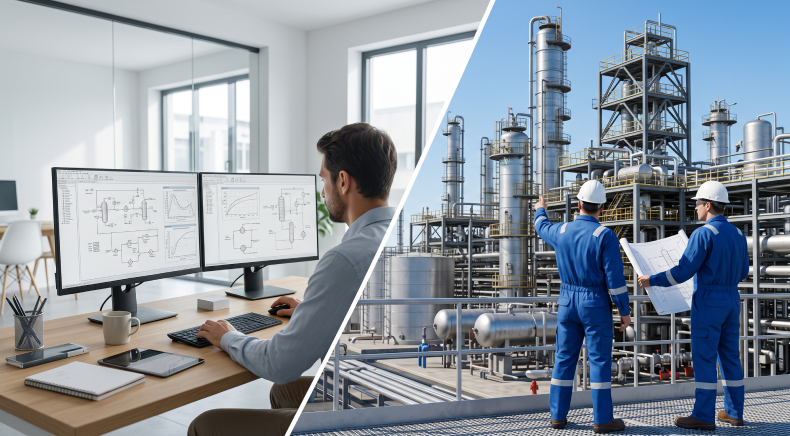
Whether you’re building a plant from scratch or upgrading an existing facility, understanding the difference between brownfield and greenfield detailed engineering is critical. It influences everything—from design decisions and timelines to risk levels and execution strategy. And, in simpler terms: Greenfield projects allow you to design freely. Brownfield projects force you to design smart.
In this blog, we’ll cover the fundamentals of greenfield and brownfield detailed engineering, compare their key differences, review challenges (and practical solutions), outline how to choose the right approach, highlight industry-specific considerations, and explain how Rishabh Pro Engineering can help.
What is Greenfield Detailed Engineering?
Greenfield detailed engineering refers to the design and development of a facility on a completely new site, without any existing infrastructure constraints.
This means engineers start with a blank canvas.
Key Characteristics:
- No legacy systems or layout limitations
- Full control over plant design and configuration
- Ability to integrate latest technologies from the beginning
- Long-term scalability can be planned upfront
What It Looks Like in Practice:
In detailed engineering of greenfield projects, teams focus on:
- Creating optimized plant layouts
- Designing efficient piping routes
- Planning utilities from scratch
- Ensuring compliance with global codes and standards
- Developing coordinated 3D models across disciplines
Since everything is designed together, coordination between process, piping, electrical, and civil teams tends to be smoother.
The Advantage:
The biggest advantage of greenfield detailed engineering is design freedom. You’re not correcting past decisions—you’re building the right system from day one.
But There’s a Catch:
- Higher capital investment
- Longer project timelines
- Greater pressure to get early decisions right
Because once construction starts, changes become expensive.
What is Brownfield Detailed Engineering?
Brownfield detailed engineering involves modifying, upgrading, or expanding an existing facility. Unlike greenfield, this is not about starting fresh, it’s about working within reality.
Key Characteristics:
- Existing equipment and infrastructure must be retained or adapted
- Space constraints are common
- Projects often run alongside live plant operations
- Data (like as-built drawings) may be incomplete or outdated
What It Looks Like in Practice:
In detailed engineering for brownfield plants, teams must:
- Validate existing conditions through site surveys or laser scanning
- Integrate new systems with legacy infrastructure
- Design within tight spatial constraints
- Plan around shutdown windows and operational continuity
The Advantage:
- Lower capital investment compared to greenfield
- Faster implementation in many cases
- Better utilization of existing assets
The Real Challenge:
The biggest challenge in brownfield detailed engineering is uncertainty.
You are not just designing—you are:
- Verifying
- Adapting
- Troubleshooting
And often doing all three at the same time.
Greenfield vs. Brownfield Detailed Engineering: Key Differences
Here’s how the brownfield vs greenfield detailed engineering differences play out in real-world scenarios:
| Aspect | Greenfield | Brownfield |
| Starting Point | Begins on a blank site with no legacy constraints, enabling engineers to define layouts, systems, and infrastructure entirely based on project requirements and long-term vision. | Begins within an existing facility where infrastructure, equipment, and operations already exist, requiring design decisions to align with current layouts, limitations, and ongoing plant activities. |
| Design Flexibility | High flexibility to optimize layouts, select technologies, and design systems without spatial or operational constraints, allowing efficient, scalable, and future-ready engineering solutions. | Limited flexibility due to space constraints, existing systems, and operational dependencies, requiring adjustments, compromises, and innovative workarounds to integrate new designs effectively. |
| Data Reliability | High data reliability as inputs are generated through controlled surveys, studies, and design assumptions, ensuring accuracy and consistency throughout engineering and execution phases. | Often uncertain data due to outdated drawings, undocumented modifications, or incomplete records, requiring extensive site validation, laser scanning, and assumptions to bridge information gaps. |
| Engineering Approach | Primarily optimization-focused, aiming to achieve ideal process efficiency, cost-effectiveness, and operability by designing systems from first principles without legacy restrictions. | Constraint-driven approach where engineering must adapt to existing conditions, balancing performance improvements with feasibility, safety, and minimal disruption to current operations. |
| Risk Type | Risks are mainly related to planning, coordination, and execution, including schedule delays, cost overruns, and design changes due to evolving project requirements or stakeholder inputs. | Risks stem from integration challenges, unforeseen site conditions, and hidden issues such as undocumented systems, increasing chances of rework, delays, and operational disruptions. |
| Complexity Type | Complexity is largely conceptual, involving technology selection, system integration, and planning decisions made during design stages before physical execution begins. | Complexity is physical and operational, involving working within congested spaces, managing live systems, and coordinating construction without interrupting ongoing plant operations. |
| Tie-In Engineering | Minimal tie-ins required as systems are newly designed and installed, allowing seamless integration within the project scope without dependency on existing infrastructure. | Critical and complex tie-ins required to connect new systems with existing ones, demanding precise planning, shutdown coordination, and risk mitigation to avoid operational disruptions. |
| 3D Modeling Approach | Built from scratch using design intent, enabling clean, structured models with standardized layouts, easier clash detection, and better coordination across engineering disciplines. | Developed using point cloud data or existing models, requiring reconstruction of as-built conditions, handling inconsistencies, and ensuring accurate integration within congested environments. |
| Shutdown Dependency | Limited dependency on shutdowns as construction occurs independently, allowing continuous progress without impacting operations, except during final commissioning and system integration phases. | Highly dependent on planned shutdowns for safe tie-ins and modifications, requiring strict scheduling, coordination, and execution within narrow time windows to minimize production losses. |
What This Really Means:
In greenfield vs brownfield detailed engineering, the shift is from:
- Freedom → Constraint
- Planning → Problem-solving
- Designing systems → Integrating systems
That’s why even smaller brownfield projects can feel more complex than large greenfield ones.
Brownfield vs. Greenfield Detailed Engineering: A Discipline-wise Deep Dive
To truly understand the detailed engineering of greenfield vs brownfield projects, you need to look at how each discipline is affected.
Process Engineering
- Greenfield: Enables complete freedom to design optimized process flows, select ideal technologies, and ensure efficiency from the ground up without legacy constraints. Engineers can align layouts with future scalability and operational excellence.
- Brownfield: Requires aligning new designs with existing process systems, capacities, and operational logic, often demanding compromises, debottlenecking strategies, and careful validation to avoid disrupting ongoing production.
Piping Engineering
- Greenfield: Offers clean-slate routing with adequate spacing, logical pipe corridors, and easy accessibility for maintenance. Designers can optimize layouts for safety, constructability, and long-term operability without spatial conflicts.
- Brownfield: Involves tight routing within congested environments, requiring precise clash detection, rerouting, and working around existing pipelines, structures, and equipment while ensuring minimal disruption to live plant operations.
Civil & Structural Engineering
- Greenfield: Allows foundations and structures to be designed based on new equipment loads, soil conditions, and future expansion plans, ensuring optimal safety margins and structural efficiency.
- Brownfield: Demands detailed assessment of existing structures’ load-bearing capacity, retrofitting needs, and reinforcement strategies to safely accommodate modifications without compromising integrity or plant safety.
Electrical Engineering
- Greenfield: Supports designing efficient, future-ready power distribution systems, including substations, cabling, and redundancy planning, ensuring reliability and scalability from the outset.
- Brownfield: Focuses on integrating with existing electrical infrastructure, managing load limitations, upgrading panels, and navigating cabling constraints while maintaining uninterrupted operations during implementation.
Instrumentation & Control
- Greenfield: Enables implementation of centralized, modern control systems with advanced automation, seamless integration, and real-time monitoring for optimized plant performance.
- Brownfield: Requires compatibility with legacy systems, phased upgrades, and careful integration strategies to modernize controls without disrupting existing operations or compromising system reliability.
Challenges Unique To Greenfield and Brownfield Projects
Both greenfield and brownfield projects come with distinct engineering hurdles that can impact safety, schedule, cost, and constructability. Knowing the typical risks upfront and applying proven mitigation measures helps teams avoid late changes, rework, and execution surprises.
Greenfield Challenges:
- Large-scale coordination across teams: With multiple disciplines working in parallel, misaligned inputs can trigger late redesigns. Use a single design basis, a shared 3D/BIM environment, and weekly inter-discipline reviews with clear RACI ownership. Freeze interfaces early and track actions through a centralized issue log.
- Managing long project timelines: Long lead items, permitting, and sequential approvals can stretch schedules and inflate costs. Build an integrated master schedule, start permitting and procurement early, and use stage-gate design reviews to prevent downstream churn. Maintain a risk register and rebase line proactively when scope changes.
- Balancing cost with future scalability: Overdesign raises CAPEX, but underdesign can block future expansion. Run scenario-based capacity planning and value engineering, then design “expandable” utilities (pipe racks, substations, MCC space, foundations) with defined tie-in points. Document expansion assumptions and protect space in the plot plan.
- Ensuring compliance from the ground up: Missing code requirements early can cause redesign, rework, and approval delays. Establish a compliance matrix at kickoff covering local regulations and global standards, assign discipline owners, and embed checks in design reviews. Engage authorities and safety teams early (HAZID/HAZOP, SIL, fire).
Brownfield Challenges:
- Inaccurate or missing data: Outdated as-builts and undocumented modifications create design uncertainty and site surprises. Start with a data-gathering plan: walkdowns, laser scanning, point clouds, and verification measurements. Update redlines into a controlled model/drawing set and require field verification sign-off before issuing IFC.
- Space constraints: Existing equipment, pipe racks, and access ways limit routing and installation clearances. Use 3D model studies and constructability reviews to optimize layouts, consider compact equipment or modular skids, and plan temporary removals where needed. Validate maintenance access and lifting paths before finalizing designs.
- Risk of clashes and rework: Tying new systems into congested areas often leads to interference, shutdown overruns, and expensive rework. Run frequent clash detection, use point-cloud-to-model comparisons, and apply strict change control. Hold joint constructability sessions with operations and contractors to confirm fit-up, isolations, and installation sequence.
- Working within live operational environments: Brownfield work can impact production, safety, and permits-to-work, especially around hazardous services. Develop a detailed execution and isolation plan, coordinate tie-ins with operations, and enforce SIMOPS controls. Use phased construction, temporary bypasses, and robust HSE planning (JSA, PTW, gas testing) to reduce risk.
- Managing shutdown schedules: Limited turnaround windows leave little room for design ambiguity or late material deliveries. Start shutdown planning early with a detailed scope split (pre-shutdown vs shutdown work), finalize tie-in packages, and pre-fabricate as much as possible. Align procurement, permits, and resources to a minute-by-minute execution plan.
In detailed engineering for greenfield vs brownfield plants, brownfield projects often require more experience and judgment, not just technical capability.
Choosing the Right Approach: Decision Framework for Project Owners
Selecting between brownfield and greenfield detailed engineering is a business decision as much as a technical one. The right path depends on what you’re trying to achieve, how fast you need results, and how much uncertainty you can absorb during execution.
When deciding between the two, project owners should consider:
Project Objective
- Expansion vs new capacity: Start by defining whether you need incremental throughput, debottlenecking, or an entirely new production line/site. If the objective demands a step-change in capacity or a new geography, greenfield fits better. If performance gains can be achieved by targeted upgrades, brownfield is often faster.
Budget Constraints
- Capital investment vs optimization: Compare total CAPEX, financing flexibility, and lifecycle cost, not just initial spend. Greenfield typically needs higher upfront investment but enables optimized layouts and lower operating costs over time. Brownfield can stretch budgets further by reusing assets but may carry higher integration and rework contingencies.
Timeline
- Speed vs long-term planning: If you must hit the market quickly, brownfield retrofits can deliver earlier benefits provided shutdown windows and constructability are manageable. Greenfield projects take longer due to land, utilities, permitting, and full build-out, but they support deliberate master planning and future phased expansion.
Existing Asset Value
- Can current infrastructure be reused?: Evaluate remaining life, reliability, compliance gaps, and capacity of existing equipment, structures, utilities, and control systems. If assets are modern, well-documented, and have spare capacity, brownfield reuse can be compelling. If they’re obsolete or constrained, greenfield may reduce long-term risk.
Risk Appetite
- Predictable planning risks vs uncertain integration risks: Greenfield risk is often front-loaded and predictable—scope definition, permitting, and execution logistics. Brownfield risk is more uncertain—unknown conditions, tie-in complexity, and operational constraints. Choose the option that matches your tolerance for uncertainty, and set contingencies, surveys, and stage gates accordingly.
Simple Rule:
- Choose greenfield for long-term strategic growth: Best when you need maximum design freedom, a step-change in capacity, or a future-ready site you can expand in phases. It supports optimized layout, new technology adoption, and cleaner compliance planning—at the cost of higher CAPEX and longer lead time.
- Choose brownfield for quick optimization and cost efficiency: Ideal when existing assets still have value and you want faster returns through debottlenecking, energy savings, or compliance upgrades. Success depends on accurate site data, strong constructability planning, and careful shutdown/SIMOPS management to control integration risk.
Industry-Specific Considerations
Different industries experience brownfield vs greenfield detailed engineering in distinct ways, shaped by asset maturity, regulatory pressures, and operational priorities. Each sector demands a nuanced approach to design, integration, and execution—making context-driven engineering strategies essential rather than relying on a one-size-fits-all model.
- Oil & Gas: Brownfield projects dominate due to extensive legacy infrastructure and ongoing production dependencies. Engineering efforts focus on seamless integration, strict safety compliance, and minimizing downtime. Complex tie-ins, hazardous environments, and operational continuity make detailed planning, risk mitigation, and phased execution critical for project success.
- Chemicals: Frequent process modifications and evolving product requirements drive retrofits in existing facilities. Brownfield engineering requires rigorous hazard and operability (HAZOP) studies, material compatibility checks, and precise system integration. Managing risks while maintaining plant efficiency and regulatory compliance is central to execution.
- Petrochemicals: Similar to chemicals but often larger in scale and integration complexity, petrochemical facilities rely heavily on brownfield upgrades for debottlenecking and yield optimization. Engineering must address feedstock variability, heat integration, and interconnected process units while ensuring minimal disruption to continuous operations and compliance with stringent safety norms.
- Power Plants: Projects are largely driven by efficiency improvements, emissions compliance, and life extension initiatives. Brownfield engineering involves integrating upgrades with existing systems without disrupting operations. Detailed assessment of legacy equipment, control systems synchronization, and phased implementation are essential for reliable performance enhancement.
- Manufacturing: Brownfield projects support capacity expansion and incremental upgrades within existing setups, while greenfield projects enable new product lines, automation, and digital transformation. Engineering strategies must balance operational continuity with innovation, ensuring scalability, optimized layouts, and future-ready infrastructure aligned with production goals.
- Green Hydrogen: Predominantly greenfield due to emerging infrastructure requirements, these projects demand integration of renewable energy sources, electrolyzers, and storage systems from the ground up. Engineering focuses on modular design, energy optimization, and scalability. However, brownfield opportunities are emerging through integration with existing industrial clusters and refineries.
- Cryogenics: Both greenfield and brownfield projects require high precision due to extreme temperature conditions. Brownfield engineering involves retrofitting storage and handling systems into existing facilities, while greenfield projects focus on specialized material selection, insulation design, and safety systems. Managing thermal stresses and ensuring system integrity are key challenges.
- Water & Wastewater Treatment: Brownfield upgrades are common for capacity expansion, regulatory compliance, and technology upgrades in existing plants. Engineering must work within spatial constraints and existing hydraulic profiles. Greenfield projects, on the other hand, allow for optimized layouts, advanced treatment technologies, and energy-efficient designs tailored to future demand.
- Carbon Capture: A rapidly evolving domain where both brownfield and greenfield approaches coexist. Brownfield projects focus on integrating capture units into existing emission sources like power plants and refineries, requiring careful tie-ins and minimal disruption. Greenfield projects enable end-to-end design of capture, transport, and storage systems, emphasizing process efficiency and long-term scalability.
How Rishabh Pro Engineering Supports Brownfield and Greenfield Detailed Engineering?
Handling brownfield vs greenfield detailed engineering effectively requires a mix of technical expertise, structured workflows, and real-world execution experience. This is where Rishabh Pro Engineering brings a strong advantage.
Seamless FEED to Detailed Engineering Transition
Rishabh Pro Engineering team ensures that early-stage concepts are translated into:
- Clear
- Coordinated
- Execution-ready designs
Reducing ambiguity and rework during construction.
Multidisciplinary Engineering Integration
With expertise across:
- Process Engineering
- Piping Engineering
- Equipment Engineering
- Electrical Engineering
- Instrumentation and Control Engineering
- Civil & Structural Engineering
Rishabh Pro Engineering team delivers fully integrated engineering solutions, minimizing clashes and delays.
Brownfield Engineering Expertise
For brownfield projects, the approach includes:
- Site validation using advanced tools
- Point cloud to 3D modeling for accurate as-is digital representation
- Accurate 3D modeling aligned with real site conditions
- Intelligent design within existing constraints
- Risk identification and clash detection before execution
Greenfield Engineering Optimization
For greenfield projects, focus areas include:
- Efficient plant layout planning
- Scalable and future-ready designs
- Code-compliant engineering
- Cost optimization
Technology-Driven Engineering
Using modern tools and platforms, Rishabh Pro Engineering team ensures:
- Better visualization
- Faster design cycles
- Improved coordination
Execution-Focused Approach
The goal is not just to design—but to ensure:
- Constructability
- Safety
- Maintainability
- Operational efficiency
Final Words
The discussion around greenfield vs brownfield detailed engineering isn’t about which is better, it’s about what fits your project’s realities. Greenfield projects enable flexibility and optimization, while brownfield projects demand precision, adaptability, and deep understanding of existing systems. What remains constant in both cases is this: detailed engineering is where project outcomes are truly defined.
Understanding these differences helps project owners make informed decisions, reduce risks, and ensure smoother execution. Partnering with the right detailed engineering company, one that combines technical expertise with real-world execution insight and can transform even the most complex challenges into well-planned, successful projects.