Industrial facilities rely on a wide range of engineered equipment—from pressure vessels and heat exchangers to storage tanks, process skids, piping systems, and rotating machinery—to ensure safe and efficient operations. As industries pursue higher production capacities, improved energy efficiency, and stricter environmental compliance, equipment must deliver reliable performance under increasingly demanding operating conditions.
Traditional design approaches often prioritize conservative safety margins, which can result in heavier equipment, higher material consumption, increased fabrication costs, and unnecessary maintenance challenges. Modern equipment design optimization for industrial plants addresses these limitations by refining equipment geometry, material selection, structural integrity, and manufacturability while maintaining compliance with applicable engineering standards.
Using advanced CAD modeling, simulation tools, and multidisciplinary engineering expertise, organizations can optimize equipment design to improve operational efficiency, extend service life, reduce lifecycle costs, and accelerate project execution.
This article explores the objectives of design optimization for industrial equipment, the engineering methods used, common optimization challenges, and how experienced engineering partners help industries achieve high-performance equipment designs.
What Is Equipment Design Optimization for Industrial Plants?
Equipment design optimization for industrial plants is the systematic process of improving the designs to achieve the best balance between performance, safety, manufacturability, reliability, and cost.
Rather than simply reducing weight or minimizing material usage, industrial equipment design optimization evaluates multiple engineering parameters simultaneously to develop equipment that performs efficiently throughout its operational lifecycle.
Optimization considers several critical factors, including:
- Structural integrity under operating loads
- Material efficiency
- Pressure and temperature requirements
- Fatigue performance
- Corrosion resistance
- Manufacturing feasibility
- Inspection and maintenance accessibility
- Compliance with industry standards
By evaluating these aspects together, engineers can create equipment designs that meet both technical and commercial objectives.
Key Objectives When Optimizing Industrial Equipment Design
Every optimization project begins with clearly defined engineering goals. While priorities vary by application, most projects aim to improve equipment performance while reducing overall project and operating costs.
- Improve Structural Performance: Industrial equipment is exposed to pressure loads, thermal expansion, vibration, cyclic stresses, and environmental conditions. Optimized designs distribute these loads more effectively, minimizing stress concentrations and improving long-term reliability.
- Reduce Material Consumption: Material costs represent a significant portion of equipment manufacturing expenses. Engineers optimize wall thickness, reinforcement layouts, support structures, and component geometry to achieve required strength with efficient material utilization.
- Enhance Manufacturability: Effective design optimization for industrial equipment also considers fabrication processes such as welding, machining, forming, and assembly. Designs that are easier to manufacture reduce production time, improve quality, and lower fabrication costs.
- Improve Maintainability: Equipment should be designed for easy inspection, servicing, and component replacement. Better accessibility reduces maintenance downtime and simplifies lifecycle asset management.
- Ensure Regulatory Compliance: Optimization never compromises safety. Equipment designs must satisfy applicable standards such as ASME, API, ISO, PED, or customer-specific specifications while delivering improved performance.
Core Methods and Tools Used in Industrial Equipment Design Optimization
Modern engineering teams combine digital technologies with practical engineering expertise to optimize equipment designs before fabrication begins.
- Advanced 3D CAD Modeling: Parametric CAD platforms enable engineers to rapidly evaluate design alternatives by adjusting dimensions, configurations, reinforcement details, and component layouts. This flexibility supports faster design iterations while maintaining model accuracy.
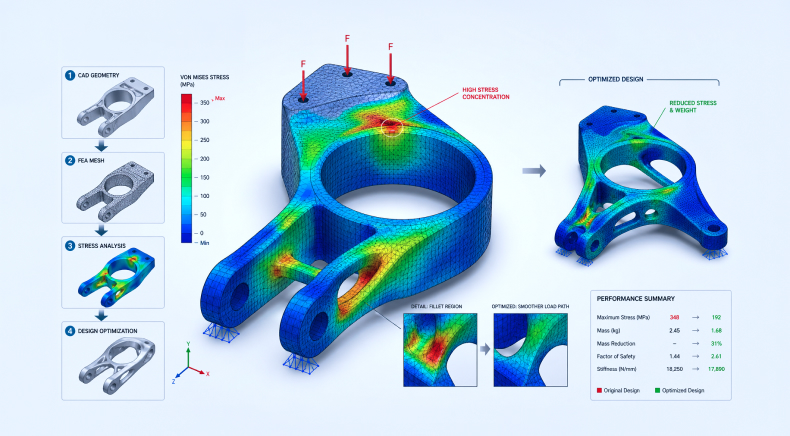
- Finite Element Analysis (FEA): Finite Element Analysis is one of the most widely used techniques for optimizing industrial equipment design. Engineers simulate operating conditions to evaluate stress distribution, deformation, fatigue performance, buckling, and thermal effects before manufacturing begins.
- Computational Fluid Dynamics (CFD): For equipment involving fluid flow, CFD helps optimize internal geometries by analyzing pressure drops, flow distribution, heat transfer, and turbulence. This improves hydraulic performance while reducing energy consumption.
- Design for Manufacturability (DFM): DFM evaluates whether optimized designs can be fabricated efficiently using available manufacturing processes. Engineers simplify weld preparations, machining operations, and assembly requirements to reduce production complexity.
- Material Engineering: Selecting the appropriate material is critical to achieving long-term equipment performance. Engineers assess operating temperatures, corrosion resistance, fatigue life, weldability, and cost to identify the most suitable material for each application.
Equipment Types Commonly Optimized in Industrial Plants
Design optimization benefits virtually every category of industrial equipment.
- Pressure Vessels: Engineers optimize shell thickness, nozzle reinforcement, support arrangements, and structural stability while ensuring compliance with pressure vessel design codes.
- Heat Exchangers: Optimization improves thermal performance, reduces pressure losses, enhances maintainability, and minimizes fabrication costs through efficient component layouts.
- Process Skids: Modular process skids benefit from optimized structural frames, piping layouts, equipment placement, lifting arrangements, and maintenance accessibility.
- Storage Tanks: Storage tanks are optimized for structural integrity, seismic performance, wind loading, roof configurations, and foundation interactions while minimizing material usage.
- Rotating Equipment: Equipment such as pumps, compressors, and blowers requires careful optimization of support, alignment, vibration characteristics, thermal expansion, and maintenance accessibility.
- Material Handling Systems: Conveyors, lifting equipment, and handling structures benefit from improved load distribution, fatigue performance, and structural efficiency while maintaining operational safety.
Optimizing Industrial Equipment Design: A Step-by-Step Approach
Successful optimization follows a structured engineering workflow that integrates multiple disciplines throughout the project lifecycle.
- Define Functional Requirements: The process begins by understanding operating conditions, process requirements, environmental factors, client specifications, applicable codes, and performance expectations.
- Develop Initial Equipment Design: Engineers prepare preliminary 3D models and engineering calculations that establish baseline design configuration.
- Perform Engineering Analysis: Using FEA, CFD, thermal analysis, and other simulation tools, engineers evaluate structural behavior, fluid flow, vibration, and thermal performance under expected operating conditions.
- Evaluate Design Alternatives: Multiple design iterations are compared to identify opportunities for improving strength, reducing weight, simplifying fabrication, and enhancing maintainability without compromising safety.
- Validate Compliance: Optimized designs are reviewed against applicable engineering codes, customer specifications, and industry standards to ensure regulatory compliance.
- Finalize Manufacturing Documentation: After optimization is complete, engineers generate fabrication drawings, detailed BOMs, assembly documentation, and quality inspection requirements to support manufacturing.
Common Challenges in Industrial Equipment Design Optimization
Although digital engineering technologies have transformed equipment development, several challenges remain.
- Balancing Performance and Cost: Improving performance while controlling fabrication costs requires careful engineering decisions and extensive design evaluations.
- Managing Multiple Design Constraints: Engineers must simultaneously consider structural loads, thermal expansion, manufacturability, maintenance access, transportation limitations, and regulatory compliance.
- Integrating Multidisciplinary Inputs: Equipment, civil and structural, piping, process, electrical, and instrumentation and control disciplines must work collaboratively to avoid downstream design conflicts.
- Working with Legacy Equipment: Many industrial plants require optimization of existing assets rather than completely new designs. Reverse engineering, laser scanning, and brownfield integration often become essential components of the optimization process.
- Reducing Development Time: Project schedules continue to shrink while equipment complexity increases. Digital simulation enables faster decision-making without sacrificing engineering quality.
Why Partner with Rishabh Pro Engineering for Industrial Equipment Design Optimization
At Rishabh Pro Engineering, we deliver comprehensive equipment design optimization for industrial plants by combining equipment engineering services experience, advanced simulation capabilities, and multidisciplinary engineering.
Our engineering teams help clients optimize equipment designs across oil & gas, chemical processing, power generation, hydrogen, manufacturing, and industrial infrastructure projects.
Our capabilities include:
- Industrial equipment design and detailing
- Pressure vessel and heat exchanger engineering
- Process skid design
- Structural analysis and piping design
- 3D CAD modeling and product development
- Finite Element Analysis (FEA)
- Computational Fluid Dynamics (CFD)
- Design validation and optimization
- Reverse engineering and brownfield modernization
- Manufacturing documentation and fabrication support
By integrating engineering analysis with practical manufacturing knowledge, we help clients optimize equipment design, improve reliability, reduce material usage, accelerate fabrication, and enhance lifecycle performance.
Project Spotlight
Case Study: AXS-Type Floating Head Heat Exchanger Design & Detailed Engineering
Client Challenge
A global manufacturer of shell-and-tube heat exchangers and pressure vessels required the design and detailed engineering of an AXS-type floating head heat exchanger with multiple tube passes. The equipment needed to comply with ASME Section VIII Division 1 (2010 Edition) and TEMA Class R (U-Stamp) standards while addressing stringent low-temperature operating conditions, nozzle reinforcement requirements, and fabrication constraints. The client was also seeking support for comprehensive fabrication documentation to streamline manufacturing and quality assurance.
Engineering Solution
Rishabh Pro Engineering designed and developed the complete engineering package for the AXS-type floating head heat exchanger featuring 10 tube-side passes and double crossflow on the shell side. The engineering team performed mechanical calculations, WRC nozzle evaluations, impact test assessments, and PWHT/PFHT evaluations using industry-standard engineering software to ensure full code compliance. Additionally, comprehensive General Arrangement (GA), fabrication, and component-level drawings were prepared to support efficient manufacturing, inspection, and future maintenance activities.
Key Deliverables
- Equipment design of AXS-type floating head heat exchanger
- General Arrangement (GA) drawings
- Detailed fabrication drawings
- Major design review documentation
- WRC calculations for process nozzles and lifting lugs
- Bill of Materials (BOM)
- Material technical requirements and forging sketches
- Detailed drawings for heat exchanger components, including girth flanges, tube bundles, tube sheets, baffles, pass partitions, gaskets, bolting, saddles, and nozzle details
- Wind, seismic, and nozzle load calculations
- Inspection, operation, and maintenance documentation
Business Impact
By delivering a fully code-compliant and fabrication-ready engineering package, Rishabh Pro Engineering enabled the client to accelerate manufacturing while minimizing design risks and ensuring compliance with ASME and TEMA requirements. The optimized equipment design, comprehensive fabrication documentation, and detailed engineering calculations improved production efficiency, simplified quality inspections, reduced fabrication errors, and supported reliable long-term operation of the heat exchanger in demanding industrial environments.
Concluding Thoughts
As industrial facilities continue to pursue greater efficiency, reliability, and sustainability, industrial equipment design optimization has become a strategic engineering capability rather than simply a design exercise.
Through advanced modeling, engineering simulation, and multidisciplinary collaboration, organizations can optimize equipment design to reduce lifecycle costs, improve manufacturability, enhance operational reliability, and ensure compliance with industry standards.
Whether developing new process equipment or modernizing existing assets, investing in design optimization for industrial equipment enables manufacturers and plant operators to build safer, smarter, and more efficient facilities that deliver long-term operational value.