A technically compliant design is not automatically the right design.
Engineering standards, specifications, codes, and project requirements provide the framework within which a design must be developed. But they do not always tell engineers whether the assumptions behind that design are correct, whether the inputs reflect actual site conditions, or whether a technically acceptable solution will remain practical during construction, operation, maintenance, or future modification.
That is why an effective engineering design review needs to go beyond compliance. The real value of a review is not simply identifying whether a drawing, calculation, model, or specification meets a defined requirement. It is determining whether the engineering decisions behind that deliverable are appropriate for the project.
An experienced engineering team therefore asks questions such as:
- Is the design basis still valid?
- Are the inputs reliable?
- Which assumptions could materially affect the design?
- Have interfaces between disciplines been adequately considered?
- Can the proposed design be constructed?
- Will operators and maintenance teams be able to access critical equipment?
- What happens if the existing site conditions differ from the available documentation?
- Could a compliant design create downstream cost, schedule, or execution risks?
This is where engineering design review beyond compliance becomes valuable, not as an additional layer of checking, but as a structured way to improve engineering decisions before they become difficult or expensive to change.
Compliance Is the Starting Point, Not the Finish Line
Compliance reviews have an important purpose. They establish whether a design satisfies applicable codes, standards, specifications, contractual requirements, and defined project criteria.
But compliance generally answers:
“Does the design meet the stated requirement?”
An engineering review should also ask:
“Is this the right requirement, input, assumption, or design approach for the situation?”
Consider a piping route that satisfies the applicable design code and project specification. On paper, it may appear completely acceptable.
But what if the route:
- Creates difficult access for maintenance?
- Requires an impractical installation sequence?
- Conflicts with structural members?
- Creates unnecessary pipe support complexity?
- Increases the length and cost of the piping system?
- Creates difficult access to valves and instruments?
- Leaves insufficient space for future equipment removal?
None of these issues necessarily means the design is non-compliant. They demonstrate why compliance and engineering judgment serve different purposes. A strong review therefore looks beyond whether the design can be justified technically and examines whether it makes sense within the broader project context.
Design Review vs Compliance Review
Understanding the difference between design review vs compliance review helps clarify why both are necessary.
| Compliance Review | Engineering Design Review |
| Checks against codes and standards | Evaluates engineering decisions |
| Verifies specified requirements | Challenges whether assumptions are appropriate |
| Focuses on defined criteria | Considers project-specific conditions |
| Identifies non-conformities | Identifies potential project risks |
| Primarily checks the deliverable | Examines the reasoning behind the deliverable |
| Establishes technical compliance | Considers constructability, maintainability and lifecycle impact |
Neither approach replaces the other. Compliance establishes an essential technical baseline. Engineering review adds context, judgment, and risk awareness around the decisions that produced the design.
The distinction becomes particularly important when a project involves complex interfaces, incomplete information, brownfield conditions, tight schedules, or significant downstream construction activity.
Five Assumptions Engineering Reviews Should Challenge
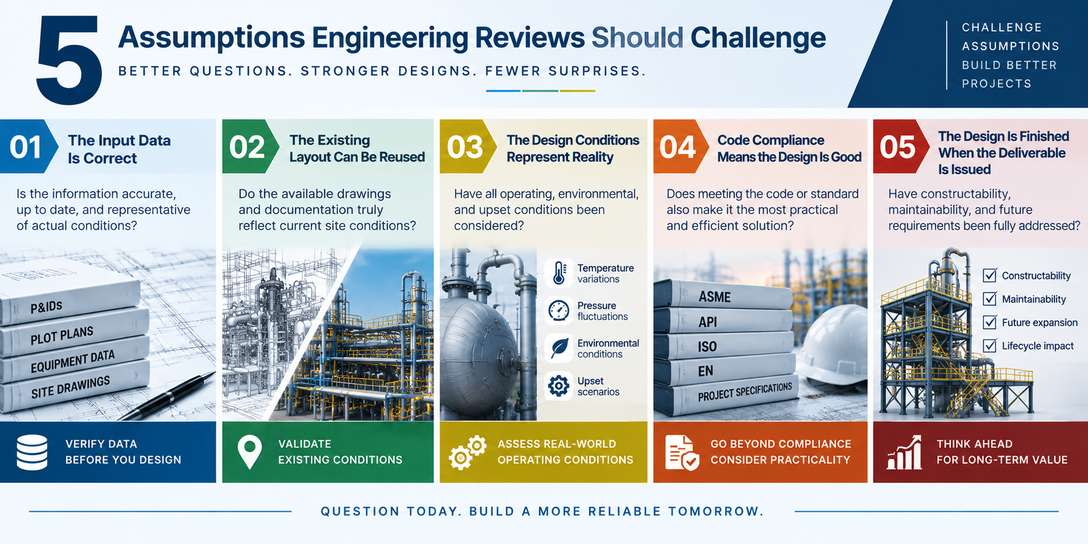
Not every assumption deserves the same level of scrutiny. Experienced teams focus on assumptions that could significantly influence cost, schedule, safety, constructability, operability, or future changes.
“The Input Data Is Correct”
Engineering teams often inherit information from previous project phases, existing drawings, vendors, surveys, or client databases. But inherited information is not automatically current information. For brownfield projects, the difference between documented conditions and actual field conditions can be particularly significant.
A review should therefore ask:
When was the information generated, and what evidence confirms that it still represents reality?
Where necessary, teams may recommend site verification, laser scanning, additional measurements, or other validation activities before detailed design progresses.
“The Existing Layout Can Be Reused”
Existing infrastructure can appear to offer an obvious starting point. But reuse may introduce constraints that are not immediately visible.
For example:
- Existing access routes may be inadequate.
- Structural capacity may be limited.
- Existing support may not accommodate new loads.
- Equipment removal paths may be obstructed.
- New piping may require complex routing.
- Existing systems may not have sufficient space for expansion.
The right question is not simple:
“Can we fit the new design into the existing layout?”
It is: “Does reusing this arrangement remain the most practical engineering solution?”
“The Design Condition Represents Reality”
Design calculations depend on defined operating and design conditions. However, projects can involve varying operating modes, transient conditions, startup and shutdown scenarios, environmental effects, or future operating requirements.
A review should identify which conditions govern the design and whether those conditions have been properly understood. This is particularly important for engineering disciplines such as piping stress analysis, structural analysis, industrial equipment engineering, and process engineering, where changes in assumptions can propagate into downstream design decisions.
“Code Compliance Means the Design Is Good”
Meeting a code requirement is essential. But two designs can both comply with the same requirements while differing considerably in:
- Constructability
- Maintenance access
- Material quantities
- Installation complexity
- Future flexibility
- Project schedule
- Lifecycle cost
Engineering judgment is required to understand those differences. The objective is not to work around standards. It is to use standards as the baseline while considering the broader engineering and project context.
“The Design Is Finished When the Deliverable Is Issued”
Issuing a drawing or model does not necessarily mean the engineering decision-making process is complete.
A design will eventually interact with:
- Procurement
- Fabrication
- Construction
- Commissioning
- Operations
- Maintenance
A review should consider whether the design can successfully transition through these stages.
This is especially important for complex or modular projects, where decisions made during engineering can directly influence fabrication, transportation, lifting, installation, and commissioning.
How Experienced Engineering Teams Challenge Assumptions
Challenging assumptions does not mean questioning every engineering decision indefinitely.
It means applying structured engineering judgment to the decisions that matter most.
Identify Critical Assumptions
First, identify assumptions that could materially affect the project. Not every assumption carries the same risk. The focus should be on those connected to major design decisions, interfaces, cost, schedule, safety, or execution.
Trace Assumptions to Their Source
Ask where the information came from.
Is it based on:
- A current survey?
- A verified drawing?
- A vendor document?
- A previous engineering package?
- A site measurement?
- A client assumption?
- Engineering judgment?
Understanding the source helps determine whether additional validation is necessary.
Test the Consequences
The next question is:
“What happens if this assumption is wrong?”
If the answer is a minor drawing revision, the risk may be manageable. If it could result in major rework, fabrication changes, structural modifications, procurement delays, or site disruption, the assumption deserves greater attention.
Review Cross-Discipline Impact
A design decision should be reviewed beyond the discipline that originally made it.
For example, changing equipment location could affect:
Process → Piping → Structural → Electrical → Instrumentation → Civil → Construction
Understanding this change propagation early can prevent multiple downstream revisions.
Challenge Constructability
A design may look excellent in a model and still be difficult to build.
Review teams should consider:
- Installation sequence
- Equipment access
- Lifting requirements
- Temporary works
- Welding access
- Transportation limitations
- Fabrication capabilities
- Site constraints
Constructability should not be treated as a final-stage check. It should influence design decisions early.
Consider Maintainability
The plant will be operated and maintained long after the engineering team has completed the project. Reviews should therefore consider whether operators and maintenance teams can safely access:
- Valves
- Instruments
- Equipment
- Removable components
- Platforms
- Inspection points
- Maintenance areas
A design that minimizes initial footprint but creates long-term maintenance difficulties may not represent the most effective engineering solution.
Why This Matters Even More in Brownfield Projects?
Brownfield engineering is where assumption-challenging becomes particularly important. Existing plants contain information that may be incomplete, outdated, inconsistent, or difficult to verify.
- Drawings may not perfectly represent current conditions.
- Equipment may have been modified.
- Piping may have changed since the original design.
- Structures may have undergone additions or alterations.
The question therefore becomes:
Does our understanding of the existing asset accurately represent what is actually there?
This is where tools such as laser scanning, point-cloud data, site verification, 3D modeling, and multidisciplinary coordination can provide valuable evidence.
For brownfield engineering, validating existing conditions before committing to detailed design can prevent a seemingly small assumption from becoming a major site problem.
When Compliance Is Not Enough: A Practical Example
Consider a project involving modifications to an existing industrial facility. The available documentation indicates that a new system can be connected to an existing area. The preliminary arrangement appears feasible, and the proposed design can be developed in accordance with applicable standards. A compliance-focused review may confirm that the design meets the required criteria.
An engineering review asks additional questions:
- Is the existing information current?
- Has the proposed tie-in location been physically verified?
- Is there sufficient access for installation?
- Can the new piping be supported without major structural modifications?
- Can equipment be removed in the future?
- Are existing utilities affected?
- Does the proposed route interfere with operations?
- Are civil, electrical, and instrumentation requirements being considered?
- What happens if the field condition differs from the drawing?
These questions can reveal risks before detailed modeling, fabrication, or construction begins. That is the difference between checking a design and interrogating the decisions behind it.
What Happens When Assumptions Aren’t Challenged?
Unchallenged assumptions can create a chain reaction. Incorrect input can influence equipment arrangement. That arrangement can influence piping. The piping can affect structural design.
Structural changes can affect foundations. The resulting modifications can affect procurement, fabrication, construction, and schedule. By the time the original assumption is discovered, correcting it may require multiple disciplines to revisit their work.
This is why early engineering review can have disproportionate value. The objective is not to eliminate every possible change. It is to identify the changes that are expensive to discover late.
Engineering Design Review Checklist
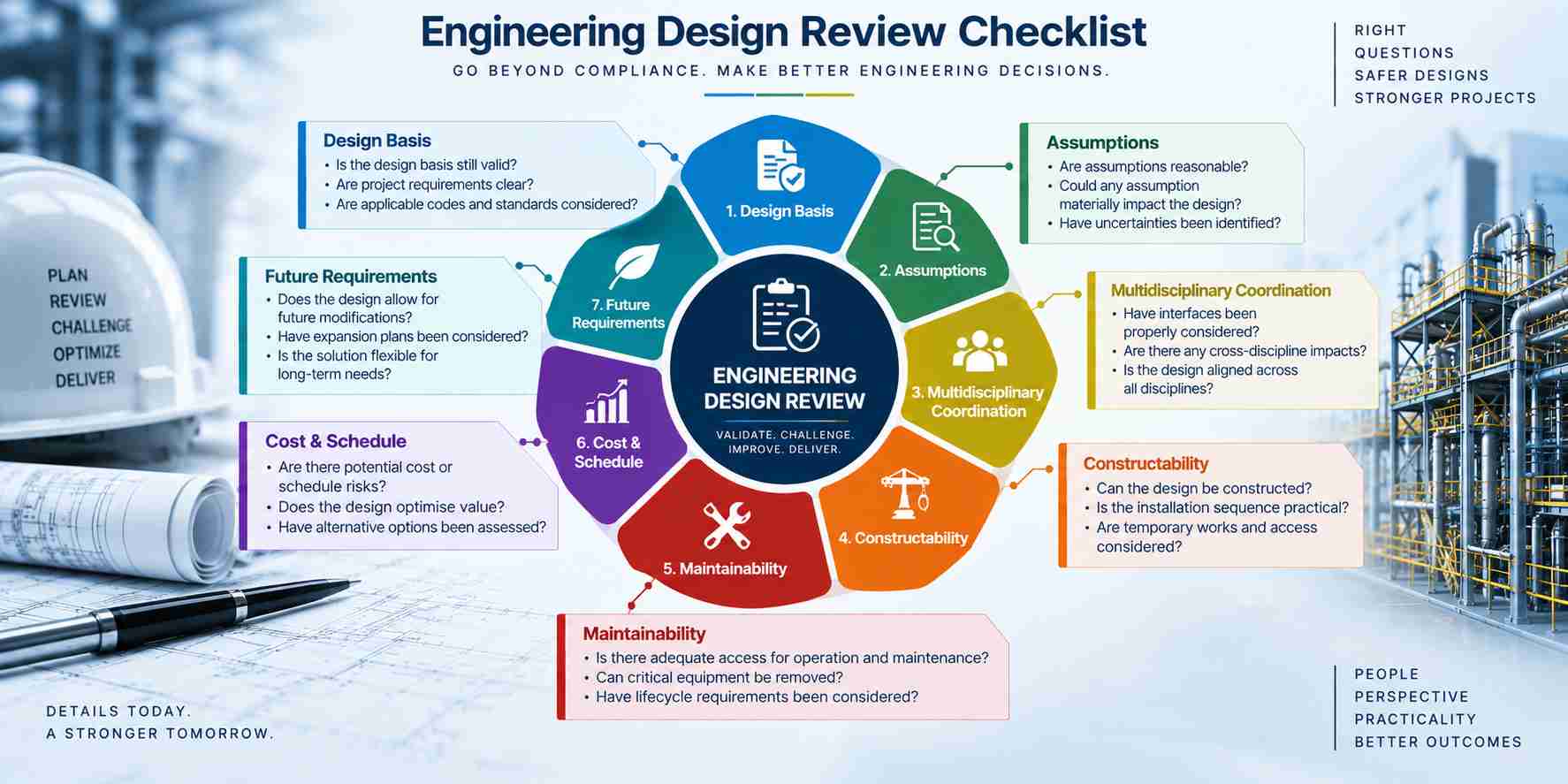
A practical engineering design review checklist can help teams bring consistency to technical reviews while ensuring that important assumptions, interfaces, and execution considerations are not overlooked. However, the purpose of the checklist is not simply to confirm that individual items have been reviewed. It is to provide a structured framework for applying engineering judgement to the design.
Design Basis
Every design review should begin with the design basis. Engineers need to confirm that the latest design option, project requirements, process conditions, operating parameters, and vendor information are being used. If the design basis has changed but the analysis or model has not been updated accordingly, the resulting conclusions may no longer represent the current project requirements.
Assumptions
Engineering calculations are only as reliable as the assumptions supporting them. A review should identify the assumptions made during analysis and determine which ones could materially influence the design outcome. Critical assumptions should be validated wherever possible, and additional site data, vendor information, field measurements, or technical investigation should be requested when existing information is insufficient.
Multidisciplinary Coordination
A design rarely exists in isolation. Changes in one discipline can affect piping, structural, mechanical, process, electrical, instrumentation, or other engineering requirements. The review should therefore examine key interfaces and consider whether a design decision could create downstream impacts. Bringing the relevant disciplines into the review early can help identify conflicts before they become costly to resolve.
Constructability
A technical sound design must also be practical to fabricate, transport, install, and commission. Constructability reviews should consider fabrication methods, installation access, lifting requirements, equipment positioning, module boundaries, construction sequence, and site constraints. A design that performs well analytically may still require modification if it introduces unnecessary complexity during execution.
Maintainability
Design decisions should account for what happens after the facility or equipment enters operation. Engineers should consider whether valves, instruments, equipment, and other components can be safely accessed for inspection and maintenance. Space for equipment removal, replacement, and future maintenance activities should also be considered rather than treating maintainability as an issue to be addressed after the design is complete.
Cost and Schedule
Engineering decisions can have consequences beyond technical performance. A seemingly minor design change may affect material quantities, fabrication effort, procurement requirements, construction activities, or project schedule. Design reviews should therefore consider whether an option introduces additional cost or lead-time implications and whether it could result in rework later in the project.
Future Requirements
Not every future requirement can be predicted, but designs should avoid unnecessarily restricting reasonable modifications or expansion. Where project information allows, engineers should consider potential capacity increases, equipment changes, future connections, or changes in operating requirements. This is particularly relevant for facilities expected to evolve throughout their operating life.
Final Engineering Judgement
The final review should bring technical and practical considerations together. Where multiple technically feasible alternatives exist, engineers should understand the trade-offs between them rather than selecting an option solely because it satisfies a single calculation or criterion.
The final question is therefore not simply does the design comply, but is this the appropriate solution for the project’s technical, operational, constructability, maintenance, cost, and execution requirements? The checklist provides structure and the engineering judgement provides the interpretation needed to make the final decision.
How Rishabh Pro Engineering Approaches Engineering Reviews
At Rishabh Pro Engineering, we approach engineering reviews as a decision-validation exercise rather than simply a compliance or document-checking activity.
Our multidisciplinary approach considers the factors that can influence the final engineering solution, including:
- Design basis and project requirements
- Existing site conditions
- Engineering assumptions
- Interdisciplinary interfaces
- Constructability
- Maintainability
- Cost and material implications
- Project schedule
- Future modifications
- Appropriate levels of analysis and validation
Depending on project requirements, this can involve process engineering, piping design, structural engineering, 3D CAD modeling, pipe stress analysis, site data validation, and multidisciplinary coordination. And our detailed engineering services brings together all the disciplines for supporting complex engineering projects..
Real Life Case Study
A brownfield engineering engagement for a steel caster steam exhaust system upgrade demonstrates the importance of validating engineering inputs before progressing too far into detailed design.
The project involved reviewing existing point-cloud information and identifying the need for additional laser scanning to better validate plant conditions. The engineering scope then brought together updated P&IDs, 3D layouts, structural assessment, civil foundation requirements, electrical and instrumentation inputs, and material quantities. The multidisciplinary package helped establish a technically validated foundation for detailed engineering, reduce coordination gaps, improve constructability, and provide greater confidence for budgeting and execution planning.
The lesson is straightforward:
The objective of early engineering review is not to create more design iterations. It is to make better decisions before those decisions become expensive to change.
Engineering Reviews Should Ask “Why?” More Often
A good engineering review should certainly ask:
“Does this comply?”
But it should also ask:
- “Why was this approach selected?”
- “What assumption is driving this decision?”
- “What happens if that assumption changes?”
- “What does this decision mean for another discipline?”
- “Can this actually be built, operated, maintained, and modified?”
Those questions move an engineering review from compliance checking toward engineering judgment.
Standards establish the boundaries within which engineering must operate. Experienced engineering teams add another layer: understanding the project context, identifying uncertainty, testing assumptions, evaluating consequences, and selecting solutions that remain practical beyond the drawing board.
Final Words
Engineering compliance is essential, but compliance alone cannot guarantee that a design will perform as intended in the field. The strongest engineering reviews go further. They challenge critical assumptions, validate inputs, examine interdisciplinary interfaces, and consider constructability, operation, maintainability, cost, schedule, and future changes.
The value of an engineering review is therefore not measured by how many comments it generates. It is measured by how many project problems it helps prevent before they reach the field. The right engineering review does more than check whether a design is compliant. It asks whether the design makes sense.