A 3D model can be technically accurate, visually detailed, and fully coordinated, and still represents the wrong design decision. That is why experienced design engineering teams do not treat modeling as the starting point of engineering. Before developing detailed models, they first evaluate the available design alternatives against the project’s technical requirements, physical constraints, constructability, maintainability, safety, cost, and schedule.
But how do experienced teams evaluate design alternatives before modeling? The answer is not simply to compare which concept looks best in a preliminary layout. It involves understanding project constraints, defining evaluation criteria, assessing multidisciplinary impacts, challenging assumptions, and considering how each alternative could affect construction, operations, maintenance, cost, and schedule. This distinction matters because once a design decision enters detailed modeling, it rarely remains isolated. A change in equipment location can affect piping. A routing decision can drive additional structural steel. Support arrangement can influence equipment nozzle loads. A compact layout can create maintenance challenges. And a seemingly minor change made late in the engineering cycle can trigger revisions across multiple disciplines.
The real question before modeling begins is therefore not “How should we model this?” but “Which design should we model, and why?” For engineering teams supporting EPC, EPCM, brownfield, and industrial projects, this early evaluation is often where engineering judgment creates the greatest value.
In this blog, we’ll explore how experienced design engineering teams evaluate alternatives before modeling, and how structured evaluation and engineering judgment help identify solutions that deliver better project outcomes.
Why Design Alternatives Should Be Evaluated Before Detailed Modeling
When project schedules are tight, there is a natural tendency to move quickly into CAD or 3D modeling. The thinking is understandable: the sooner the model is developed, the sooner clashes can be identified and drawings can be produced.
But modeling an unsuitable concept faster does not make the engineering process more efficient. Detailed modeling requires time, engineering input, coordination, reviews, and revisions. If the underlying design concept changes after substantial modeling have already been completed, the impact can extend well beyond the model itself.
It can affect:
- Equipment Arrangements
- Piping Routes & Flexibility
- Structural Requirements
- Electrical And Instrumentation Interfaces
- Civil And Foundation Requirements
- Procurement Inputs
- Material Quantities
- Fabrication
- Construction Planning
- Maintenance Access
- Project Schedule
Experienced engineering teams therefore try to resolve the high-consequence design decisions as early as possible, when changes are still relatively inexpensive. The objective is not to eliminate every possible alternative. It is to identify the alternatives that are technically viable, understand their implications, and develop the most appropriate option to a higher level of detail. Importantly, modeling should validate and develop an engineering decision, not substitute for making one.
How to Evaluate Design Alternatives Before Modeling
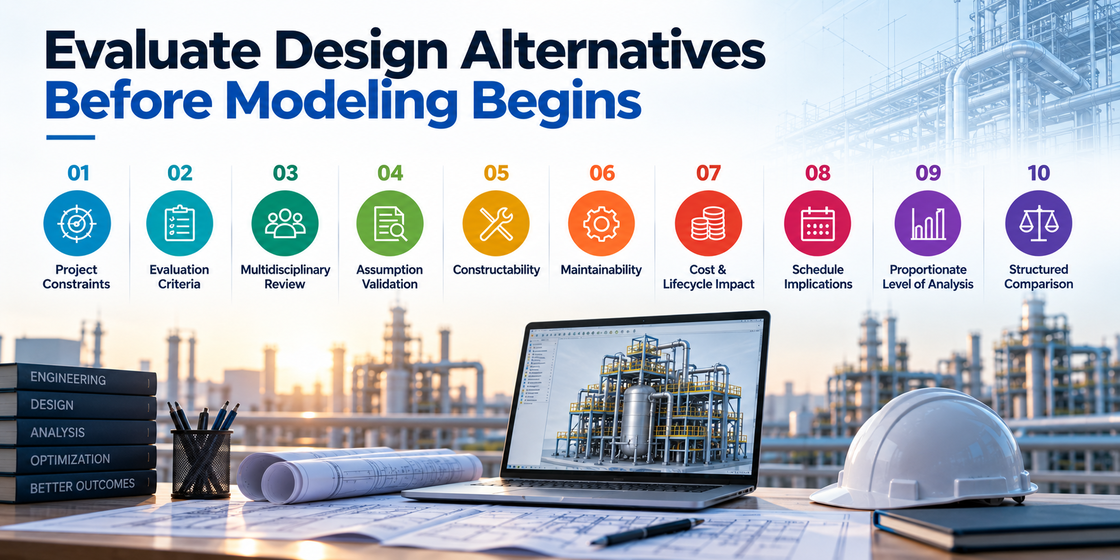
Evaluating design alternatives before modeling requires a structured approach. Rather than developing multiple detailed models and comparing them afterward, experienced engineering teams progressively screen concepts using the level of analysis appropriate to the decision. Design alternative evaluation before modeling typically follows a structured process that begins with identifying project constraints and defining evaluation criteria, followed by multidisciplinary review and assumption validation. It then considers constructability, maintainability, cost, lifecycle impact, schedule implications, the appropriate level of analysis, and structured comparison of alternatives before detailed modeling begins.
Step 1: Start With the Project Constraints, Not the Preferred Solution
Every project has constraints. Some are obvious from the beginning; others emerge as engineering progresses. Before evaluating alternatives, experienced teams establish the conditions within which the design must work.
These may include:
- Plot plan and available footprint
- Existing equipment and structures
- Battery limits
- Process requirements
- Equipment dimensions and nozzle orientations
- Operating temperature and pressure
- Applicable codes and standards
- Material requirements
- Safety requirements
- Access and maintenance clearances
- Transportation and lifting limitations
- Construction methodology
- Existing plant conditions
- Future expansion requirements
This step sounds straightforward, but it prevents an important mistake: optimizing a design against the wrong objective. For example, a compact equipment arrangement may appear attractive because it minimizes footprint and piping length. But once maintenance withdrawal space, crane access, operator movement, and equipment replacement are considered, the same arrangement may become impractical.
Similarly, the shortest piping route may not be the best route if it creates excessive flexibility requirements, difficult support arrangements, poor access, or congestion with other systems.
Experienced teams therefore ask:
What constraints are fixed, and which ones can be optimized?
That distinction provides the foundation for evaluating alternatives.
Step 2: Define What “Better” Means Before Comparing Alternatives
There is rarely a single metric that determines whether one engineering solution is better than another.
Consider three possible equipment arrangements:
- Option A requires the least material.
- Option B provides better maintenance access.
- Option C requires a slightly larger footprint but simplifies future expansion.
Which one is better?
There is no meaningful answer until the project’s priorities are understood.
Experienced teams establish evaluation criteria before selecting an alternative. Depending on the project, these may include:
Technical performance
- Process requirements
- Equipment performance
- Design margins
- Pressure drop
- Thermal requirements
- Code compliance
Safety
- Hazard exposure
- Emergency access
- Isolation requirements
- Safe operating clearances
- Fire and safety considerations
Constructability
- Fabrication requirements
- Transportation
- Erection sequence
- Field welding
- Installation access
- Temporary works
Maintainability
- Equipment removal
- Valve accessibility
- Inspection access
- Crane or lifting requirements
- Replacement pathways
- Operator access
Commercial considerations
- Material quantities
- Structural requirements
- Fabrication complexity
- Engineering effort
- Construction cost
- Potential rework
Schedule
- Procurement dependencies
- Long-lead equipment
- Fabrication duration
- Site installation sequence
- Interdisciplinary dependencies
Future requirements
- Expansion
- Capacity changes
- Additional equipment
- Tie-ins
- Modification access
This approach changes the discussion from “Which option looks best?” to “Which option performs best against the project’s actual priorities?”
Step 3: Look Beyond the Individual Discipline
One of the clearest differences between basic design development and experienced engineering is the ability to recognize second-order consequences.
- A piping engineer may identify an efficient route.
- A structural engineer may identify an efficient support arrangement.
- An equipment engineer may identify a suitable equipment orientation.
But the project does not operate as a collection of independent disciplines.
- A piping decision can influence structural steel.
- Structural changes can affect foundations.
- Equipment orientation can affect piping flexibility.
- Piping arrangements can affect instrumentation accessibility.
- Layout decisions can affect electrical routing and cable trays.
That is why experienced teams ask a simple but powerful question:
“What else changes if we choose this option?”
Consider a new equipment connection in an existing plant. One routing option may provide the shortest pipe length. However, it may:
- Require additional supports
- Cross an existing access route
- Increase congestion
- Create flexibility concerns
- Affect equipment nozzle loads
- Require structural modifications
Another option may use slightly more piping but provide better access, simpler supports, and fewer interfaces with existing systems. If the alternatives are evaluated only from a piping perspective, the first option may appear superior. If they are evaluated as a multidisciplinary engineering decision, the second option may provide a better project outcome. This is why early interdisciplinary coordination is not simply a clash-prevention exercise. It is a design decision-making exercise.
Step 4: Challenge the Assumptions Behind the Design
Not every engineering input available at the beginning of a project is equally reliable.
Some information may be:
- Preliminary
- Vendor-dependent
- Based on historical drawings
- Subject to process changes
- Awaiting site verification
- Based on assumptions
- Not yet frozen
Experienced teams distinguish between these inputs instead of treating every value as equally certain.
They ask:
- Which equipment dimensions are confirmed?
- Are nozzle orientations final?
- Are operating conditions frozen?
- Are existing plant conditions verified?
- Which vendor inputs are still preliminary?
- Which interfaces could change?
- Which assumptions could force major redesign later?
This is particularly important for brownfield projects, where existing drawings may not perfectly represent current site conditions. The objective is not to remove uncertainty before starting engineering. That is rarely realistic. The objective is to identify which uncertainties have the potential to materially change the design.
A preliminary assumption about a non-critical dimension may have little consequence. An unverified equipment nozzle location, structural elevation, or underground utility location could fundamentally change the design. Experienced teams prioritize validation accordingly.
Good engineering does not eliminate uncertainty. It identifies which uncertainty matters.
Step 5: Evaluate Constructability Before the Model Becomes Too Detailed
A design can be technically feasible and still be difficult to build.
That is why constructability needs to enter the conversation before detailed modeling is complete.
Engineers should consider:
- Can the equipment reach the installation location?
- Can large components be transported to site?
- Is there sufficient crane access?
- Can welds be performed safely?
- Can components be assembled in the planned sequence?
- Is temporary support required?
- Can prefabricated sections be installed?
- Is field modification likely?
- Are there restrictions caused by existing facilities?
This becomes particularly important in brownfield projects. A design that works perfectly in a greenfield environment may become impractical when surrounded by existing equipment, structures, operating systems, and restricted access.
Similarly, an arrangement that appears efficient in a 3D environment may be difficult to fabricate or erect because the model does not automatically account for every practical construction constraint. Experienced engineering teams therefore bring the construction perspective into design reviews early. The question is not only “Can we design it?” but also “Can the site realistically build it?”
Step 6: Evaluate Maintainability, Not Just Installation
A common design mistake is to evaluate whether something can be installed without adequately considering what happens after commissioning.
Industrial facilities may operate for decades. Equipment will eventually require:
- Inspection
- Calibration
- Repair
- Replacement
- Cleaning
- Isolation
- Overhaul
An arrangement that works on day one may create operational problems for years if maintenance requirements are not considered.
Experienced teams therefore ask:
- Can valves be accessed?
- Can instruments be reached safely?
- Can equipment components be removed?
- Is there sufficient working clearance?
- Can lifting equipment reach the maintenance area?
- Is there a realistic replacement path?
- Can maintenance activities be performed without unnecessarily disrupting surrounding systems?
A compact arrangement is not automatically an efficient arrangement. If equipment removal requires dismantling adjacent systems, the initial space saving may eventually become a significant maintenance burden. A design should not merely be installable. It should remain accessible, operable, and maintainable throughout its intended lifecycle.
Step 7: Consider the Cost of the Decision—Not Just the Cost of the Design
Cost comparisons between alternatives can be misleading when they focus only on immediate material quantities. Suppose one alternative reduces piping by 8%. That sounds positive.
But what if it also:
- Increases structural steel
- Requires more complex support
- Makes fabrication difficult
- Increase installation time
- Reduces maintenance access
- Requires additional field work
The lower initial quantity may no longer represent the lower overall project cost. Experienced teams therefore consider cost across the project lifecycle.
The evaluation may include:
Engineering cost → Procurement → Fabrication → Construction → Commissioning → Operations → Maintenance → Future modifications
This is particularly important when evaluating options with different levels of complexity. A slightly higher engineering or material cost at the front end may sometimes reduce downstream construction risk or lifecycle cost.
The right question is therefore not:
“Which design costs less to engineer?”
It is:
“Which option provides the best overall project outcome for the required investment?”
Step 8: Consider Schedule as an Engineering Parameter
Engineering decisions can have significant schedule implications.
An alternative may require:
- Additional vendor information
- More structural analysis
- Specialized fabrication
- Additional procurement
- Longer installation
- More site coordination
- More interdisciplinary reviews
Another option may be slightly less optimized from a theoretical perspective but significantly easier to execute within the project schedule. Experienced teams make these trade-offs visible.
For example, a highly customized arrangement may provide marginal performance improvements but introduce procurement or fabrication dependencies. A more standardized solution may offer sufficient performance while reducing schedule exposure.
Neither is universally correct.
The right choice depends on the project’s priorities. Engineering optimization without schedule awareness is incomplete optimization.
Step 9: Use the Right Level of Analysis for the Decision
One of the most important habits of an experienced engineering team is knowing how much analysis is enough. Not every alternative needs a fully developed 3D model.
Depending on the decision, teams may use:
- Conceptual sketches
- 2D layouts
- Preliminary equipment arrangements
- Simplified 3D models
- Routing studies
- Preliminary calculations
- Vendor data
- Existing drawings
- Point-cloud data
- Site photographs
- Design review markups
The purpose is to obtain enough information to make a sound decision without investing disproportionate effort in options that may ultimately be rejected. For example, three conceptual equipment arrangements might first be screened using footprint, access, process requirements, and constructability. Only the strongest two may then require preliminary spatial development.
The preferred option can subsequently progress into detailed 3D modeling. This staged approach can reduce unnecessary iterations while still giving engineers sufficient information to challenge the design. The objective is not to model every possibility. It is to develop enough evidence to select the right possibility.
Step 10: Use a Structured Design Alternative Evaluation Matrix
Engineering judgment is essential, but decisions should also be transparent and explainable. A simple evaluation matrix can help teams compare alternatives consistently.
For example:
| Evaluation Criteria | Weight | Option A | Option B | Option C |
| Technical feasibility | 20% | 5 | 4 | 3 |
| Constructability | 20% | 3 | 5 | 4 |
| Maintainability | 15% | 3 | 5 | 2 |
| Safety | 15% | 4 | 4 | 3 |
| Cost | 15% | 5 | 3 | 4 |
| Schedule | 15% | 4 | 4 | 3 |
The numerical scores themselves are not engineering decisions. They simply provide a structured way to make the trade-offs visible.
An experienced team will still challenge the scoring:
- Why was this option given a higher constructability score?
- What assumptions support the cost estimate?
- What happens if the vendor dimension changes?
- Is the maintenance advantage significant enough to justify the additional cost?
- Does the preferred option introduce a risk that the weighted score does not capture?
This is where engineering judgment remains critical. A decision matrix should support engineering judgment—not replace it.
A Practical Example: Choosing Between Three Piping Routes
Consider a project where a new process vessel needs to connect to an existing system.
The engineering team identifies three potential routes.
Option A — Shortest Route
The route minimizes pipe length and appears attractive from a material-cost perspective.
However, it requires:
- Additional supports
- More congested routing
- Limited access to a nearby valve
- Greater coordination with existing structures
Option B — Accessible Route
This option is slightly longer but provides:
- Better maintenance access
- Simpler support arrangements
- Improved installation access
- Better separation from existing services
The material quantity is somewhat higher.
Option C — Future-Ready Route
This route provides space for potential future expansion.
It requires a slightly larger footprint and additional initial investment but reduces the likelihood of major rerouting during a future project phase.
Which option should be selected?
There is no answer based solely on pipe length.
The engineering team needs to understand:
- Current project priorities
- Process requirements
- Flexibility requirements
- Structural implications
- Maintenance philosophy
- Construction sequence
- Future expansion plans
- Cost and schedule priorities
If the plant is highly space-constrained, Option C may not be practical. If maintenance accessibility is a major operational priority, Option B may be preferable. If the project has an aggressive schedule and low future expansion likelihood, Option A may be acceptable—provided its associated risks are manageable.
The value of experienced engineering is not having a predetermined answer. It has the framework and technical judgment to identify the right answer for the project.
Common Mistakes When Evaluating Design Alternatives
Even technically capable teams can fall into predictable traps.
- Choosing the shortest or smallest option: Less material does not automatically mean lower project cost.
- Optimizing within one discipline: Piping optimization can create a structural or construction problem elsewhere.
- Modeling too early: Developing detailed models before major design decisions are resolved can create avoidable rework.
- Treating preliminary information as final: Unverified assumptions can become embedded in downstream engineering.
- Ignoring maintenance: A design optimized for installation can become difficult and expensive to operate.
- Focusing only on CAPEX: Lower initial cost may create higher construction, operating, or maintenance costs.
- Treating compliance as the finish line: A design can comply with applicable standards and still be difficult to construct, operate, or maintain.
- Assuming the first workable option is the best option: Technical feasibility is only the first filter. The better question is whether the option provides the best overall outcome.
What Experienced Design Engineering Teams Do Differently
The difference is not simply better software, faster modeling, or more detailed drawings. It is the quality of the questions asked before those activities begin.
Experienced teams tend to:
- Challenge the brief rather than simply accept it.
- Identify alternatives rather than immediately committing to the first workable solution.
- Make trade-offs visible rather than optimizing a single parameter.
- Think across disciplines rather than treating engineering packages independently.
- Consider constructability and maintainability alongside technical performance.
- Identify high-impact assumptions before they become embedded in the design.
- Use analysis proportionately rather than overengineering every alternative.
- Document the basis for decisions so that the rationale remains clear as the project progresses.
Most importantly, they understand that an engineering decision rarely stays within engineering.
It eventually becomes a procurement decision, a fabrication decision, a construction decision, an operations decision, or a maintenance decision.
What Should Clients Expect From Rishabh Pro Engineering?
At Rishabh Pro Engineering, we approach design alternative evaluation as an engineering decision-making exercise—not simply a modeling activity.
Before progressing too far into detailed design, our teams evaluate the conditions that can influence the final solution, including project constraints, technical requirements, interdisciplinary interfaces, constructability, maintainability, cost, schedule, and potential downstream impacts.
Depending on the project, this may involve:
- Reviewing the design basis, project requirements, and existing conditions
- Identifying and validating assumptions that could materially affect the design
- Evaluating alternative layouts, routing approaches, or equipment arrangements
- Coordinating inputs across process, piping, equipment, structural, electrical, and instrumentation & control disciplines
- Assessing constructability, access, installation, lifting, and maintenance requirements
- Evaluating the potential impact of design decisions on cost, schedule, and future modifications
- Using the appropriate level of analysis—from conceptual layouts and preliminary calculations to 3D CAD modeling and detailed engineering, before committing to a final solution
Our approach is particularly valuable in complex brownfield environments, where existing conditions, limited space, operating facilities, and incomplete or changing information can significantly influence design decisions.
Putting This Approach Into Practice
A recent brownfield engineering engagement for a steel caster steam exhaust system upgrade demonstrates this approach in practice. Rishabh Pro Engineering reviewed existing point-cloud data and identified the need for additional laser scanning to validate plant conditions. The team then coordinated updated P&IDs, 3D layouts, structural assessment, civil foundations, electrical and instrumentation inputs, and material take-offs as part of an integrated multidisciplinary engineering package.
This coordinated approach helped establish a technically validated foundation for detailed engineering, reduce coordination gaps between disciplines, improve constructability, and provide greater confidence for budgeting and execution planning within an operating facility.
The objective is not to create more design iterations. It is to make better engineering decisions early, when alternatives can still be evaluated and changes can still be made without significant downstream impact.
Real Life Case Studies
Case Study 1: Using Multidisciplinary Coordination to Validate 3D Modeling of a Pilot Plant Design
For a UK-based engineering and technology company developing a 3D model of pilot plant, the challenge extended beyond creating a detailed 3D representation of the facility. The engineering team needed to ensure that equipment positioning, piping, structural elements and supporting infrastructure worked together before the design progressed toward construction.
- The 3D model was therefore developed as a design-validation environment, allowing the team to assess equipment arrangement, piping routes, support requirements, accessibility and multidisciplinary interfaces within a common environment. Potential spatial conflicts and layout constraints could be identified during engineering rather than being discovered during fabrication or site execution.
- The project demonstrates an important principle: a design alternative should not be evaluated only on whether it can be modeled. It should be evaluated on how well it performs when technical, structural, operational and constructability requirements are considered together.
- By bringing these considerations into the design stage, the engineering team could resolve coordination issues earlier and provide a more fabrication- and construction-ready design.
Case Study 2: Balancing Space, Weight and Constructability in 3D Modeling of a FPSO Metering Skid
For an FPSO metering skid, design decisions had to account for considerably more than equipment arrangement alone. The 3D modeling engineering scope included 3D modeling, piping integration, pipe stress analysis, structural calculations, fabrication drawings, material take-offs, weight and center-of-gravity calculations, and lifting analysis.
- These requirements illustrate the interconnected nature of design decisions in an offshore environment. A layout that saves space may influence piping flexibility. A change in equipment positioning can affect structural requirements, weight distribution or lifting arrangements. A fabrication-friendly configuration may need to be balanced against access and offshore installation constraints.
- Rather than optimizing individual components in isolation, the engineering process considered these interfaces together. The resulting design supported layout coordination, fabrication readiness and engineering validation before offshore integration.
- The key lesson is that “optimized” does not necessarily mean the smallest or shortest design. In complex projects, the better alternative is often the one that achieves the right balance between space, structural integrity, piping requirements, weight, lifting, fabrication and installation.
Concluding Thoughts: From Design Alternatives to Better Engineering Outcomes
Detailed modeling remains an essential part of modern engineering. Tools that enable 3D plant modeling, BIM, point-cloud integration, design automation, and engineering analysis help significantly improve design development and coordination.
But technology does not eliminate the need for engineering judgment. A sophisticated model can tell you that two systems clash. It cannot always tell you which design should have been selected in the first place. That decision requires engineers to understand the project’s objectives, constraints, risks, interfaces, constructability requirements, maintenance philosophy, and long-term implications. The strongest engineering teams therefore do not begin by asking how quickly they can create the model.
They begin by asking better questions.
- What are we trying to achieve?
- What constraints cannot be changed?
- What alternatives are available?
- What happens if we choose each one?
- What risks are we accepting?
- What will this decision mean for construction, operations, and maintenance?
And finally:
Which option gives the project the best overall outcome?
That is where experienced design engineering adds value—before the first detailed model is created.