Detailed engineering is often viewed as the stage where project concepts, preliminary designs, and engineering requirements are translated into drawings, specifications, calculations, and construction-ready deliverables. However, the quality of this stage depends heavily on decisions made before it begins.
For EPC contractors, moving into detailed engineering with incomplete design inputs, unresolved technical interfaces, uncertain vendor information, or insufficient understanding of site conditions can create problems that extend well beyond the engineering team. What initially appears to be a minor information gap can lead to repeated design revisions, procurement delays, fabrication changes, construction conflicts, and pressure on project schedules.
EPC project risks are particularly significant in complex industrial projects involving multiple engineering disciplines, specialized equipment, interconnected process systems, and demanding construction requirements. Process, piping, mechanical, civil, structural, electrical, and instrumentation teams must work from coordinated inputs and a consistent understanding of the project scope. If their assumptions differ, inconsistencies can emerge across engineering deliverables and become more difficult to resolve as the project progresses.
Identifying these risks before detailed engineering allows EPC contractors to establish clearer design requirements, prioritize critical information, coordinate stakeholders, and make informed execution decisions. It also helps engineering teams distinguish between confirmed inputs, preliminary assumptions, and dependencies that require further validation.
At Rishabh Pro Engineering, we recognize that effective engineering execution starts with understanding what could affect the design before those issues become embedded in project deliverables. Listed below are some of the important risks in EPC projects that engineering contractors should evaluate before moving into detailed engineering.
10 EPC Project Risks Every Contractor Should Identify Before Detailed Engineering
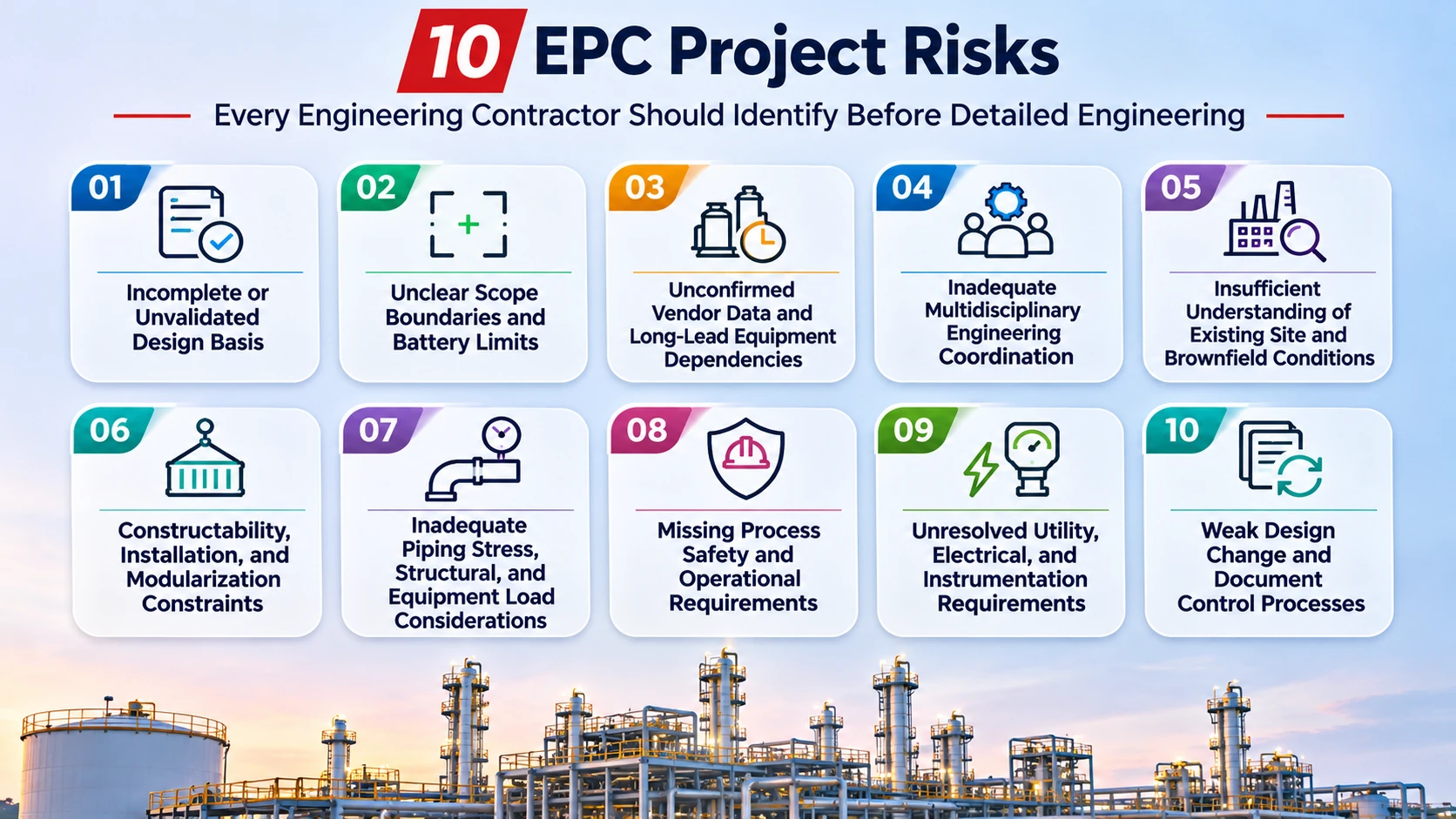
Engineering projects involve interconnected technical, commercial, and execution requirements that can introduce risks well before construction begins. Understanding common risks in EPC projects early helps engineering contractors identify potential gaps, assess project constraints, and make informed decisions before detailed engineering progresses.
Incomplete or Unvalidated Design Basis
The design basis establishes the technical foundation for engineering decisions. It defines the operating conditions, process requirements, design parameters, applicable codes, standards, project specifications, and other criteria that guide the development of engineering deliverables.
When this information is incomplete, inconsistent, or based on unverified assumptions, different engineering disciplines may progress using different interpretations of the project requirements.
For example, preliminary process conditions may change after equipment sizing has started. Revised operating temperatures or pressures can affect material selection, piping specifications, equipment design, thermal expansion assessments, and related calculations. Similarly, incomplete information about site conditions can influence structural design, foundation requirements, and equipment arrangements.
What EPC contractors should identify before detailed engineering:
- Missing or provisional process design parameters.
- Unconfirmed operating, design, and environmental conditions.
- Conflicting project specifications or applicable standards.
- Unresolved design assumptions and technical deviations.
- Requirements that have not been formally reviewed or approved.
How to address the risk
Establish a controlled design basis document and maintain assumptions register that identifies information gaps, responsible stakeholders, validation requirements, and approval status. Critical input should be reviewed before dependent engineering activities are allowed to progress.
Unclear Scope Boundaries and Battery Limits
Scope ambiguity is a common source of engineering and execution conflicts, particularly in projects involving multiple EPC contractors, technology providers, equipment vendors, and package suppliers. When battery limits and scope boundaries are not clearly defined, teams may make different assumptions about who is responsible for equipment connections, utility provisions, instrumentation, electrical interfaces, structural supports, and associated engineering deliverables.
For instance, a process package vendor may include equipment and local instrumentation within its scope but exclude external piping, utility connections, cable routing, or supporting structures. Unless these exclusions are identified early, gaps can appear between package engineering and the overall plant design. The consequences may include duplicated engineering effort, missing deliverables, procurement gaps, and delays in resolving technical interfaces.
What EPC contractors should identify before detailed engineering:
- Battery limits for process systems and equipment packages.
- Scope division between the EPC contractor, client, and vendors.
- Responsibilities for utility connections and external piping.
- Electrical, instrumentation, and control system interfaces.
- Ownership of interface drawings, calculations, and approvals.
How to address the risk
Develop a clear scope matrix and battery-limit documentation for each package and discipline. Interface registers and responsibility matrices should identify deliverable ownership, connection requirements, and dependencies between stakeholders.
Unconfirmed Vendor Data and Long-Lead Equipment Dependencies
Detailed engineering frequently progresses alongside equipment procurement. However, engineering teams cannot always wait for every vendor drawing and technical document before starting their work. The risk emerges when preliminary vendor information is treated as confirmed design input without adequately tracking the assumptions involved.
Equipment dimensions, nozzle orientations, operating loads, electrical characteristics, utility requirements, and maintenance clearances can influence multiple engineering disciplines. A late change in any of these parameters may require revisions to equipment layouts, piping models, structural arrangements, electrical systems, and supporting calculations. Long-lead equipment can introduce an additional dependency. Delays in technical bid evaluation, vendor selection, or drawing approval may affect engineering activities that depend on finalized equipment information.
What EPC contractors should identify before detailed engineering
- Long-lead equipment requires early technical evaluation.
- Vendor drawings and datasheets that remain preliminary.
- Outstanding technical queries and deviations.
- Equipment interfaces dependent on confirmed vendor information.
- Engineering deliverables that can progress using controlled assumptions.
How to address the risk
Establish a vendor document schedule aligned with the engineering deliverables schedule. Prioritize critical equipment packages, track outstanding information, and identify which design activities depend on final vendor data. Preliminary input should have clear revision status and validation requirements.
Inadequate Multidisciplinary Engineering Coordination
Industrial facilities are developed through the combined efforts of several engineering disciplines. Process requirements influence equipment selection, piping arrangements, structural loading, electrical distribution, instrumentation, and control philosophy.
When disciplines develop their deliverables independently without adequate coordination, design conflicts can remain undetected until model reviews, procurement checks, or site execution. For example, a piping route may satisfy process and stress requirements but clash with a structural member. An equipment arrangement may appear acceptable in the mechanical layout but leaves insufficient space for electrical cable routes or instrument access. Similarly, structural support may not account for piping loads or equipment maintenance requirements.
These issues can result in repeated model revisions, drawing updates, and additional coordination cycles.
What EPC contractors should identify before detailed engineering:
- Dependencies between process, piping, mechanical, and structural design.
- Electrical and instrumentation interface requirements.
- Equipment access and maintenance clearances.
- Coordination responsibilities across engineering teams.
- Requirements for regular model reviews and clash detection.
How to address the risk
Establish a multidisciplinary coordination plan before detailed design progresses. Define discipline inputs and outputs, agree on model development procedures, and schedule structured design reviews at appropriate milestones. A coordinated 3D model can help identify spatial conflicts and interface issues before construction.
Insufficient Understanding of Existing Site and Brownfield Conditions
For brownfield projects, engineering decisions must account for the existing facility rather than rely solely on available legacy drawings or preliminary site information. Existing piping routes, structural members, foundations, underground utilities, equipment locations, and operating systems can differ from the information available in project documentation. Even relatively small discrepancies can affect the feasibility of proposed modifications.
For example, a new process line may appear to have sufficient routing space in an existing plant layout but encounter an unrecorded obstruction during installation. Similarly, an equipment foundation modification may be constrained by existing underground services or adjacent operating equipment. Without reliable site information, engineering teams risk developing designs that require substantial adjustments during construction.
What EPC contractors should identify before detailed engineering:
- Availability and reliability of existing plant drawings.
- Actual equipment, piping, and structural configurations.
- Underground utilities and concealed obstructions.
- Available space for new equipment and piping connections.
- Operational constraints affecting site access and construction.
How to address the risk
Conduct appropriate site surveys and field verification before finalizing engineering inputs. Where required, laser scanning and point cloud data can support accurate capture of existing plant conditions and provide a reliable reference for 3D modeling and modification engineering. Existing drawings should be checked against verified site information before they are used as the basis for detailed design.
Constructability, Installation, and Modularization Constraints
A design may satisfy technical requirements and still be difficult to fabricate, transport, install, or maintain. Constructability considerations therefore need to be incorporated during engineering rather than addressed only when construction begins.
This becomes particularly important for modular plants, skid packages, and projects with restricted site access. Equipment arrangement, module dimensions, lifting requirements, transportation limitations, connection points, and installation sequences can influence the engineering configuration from the outset. For example, a skid package may accommodate all required equipment within the available footprint but exceed transportation restrictions. A piping arrangement may be technically acceptable but leave insufficient access for welding, inspection, or equipment maintenance. Similarly, a modular configuration may introduce complex site connections if package boundaries and interfaces are not defined early.
What EPC contractors should identify before detailed engineering
- Fabrication and assembly requirements.
- Module dimensions and transportation limitations.
- Lifting points, equipment weights, and installation access.
- Site constraints and construction sequencing.
- Maintenance access and component replacement requirements.
How to address the risk
Involve construction, fabrication, and logistics stakeholders during design development. Evaluate module boundaries, installation methods, lifting arrangements, and site connections alongside equipment layout and piping design. Early constructability reviews can help identify design decisions that may create execution difficulties.
Inadequate Piping Stress, Structural, and Equipment Load Considerations
Piping systems, supporting structures, and connected equipment must be designed to accommodate the loads they experience during operation, installation, and relevant abnormal conditions.
If these requirements are not considered early, engineering teams may encounter problems when piping stress analysis, structural calculations, or equipment load assessments are performed. For example, thermal expansion in a piping system can generate forces and moments at equipment nozzles and supports. Incorrect assumptions about support locations or boundary conditions may affect piping flexibility and load distribution. Similarly, equipment operating weights, maintenance loads, wind loads, and other applicable environmental or operational loads must be reflected in structural design.
Late identification of these issues can require routing changes, support modifications, structural strengthening, or revisions to equipment arrangements.
What EPC contractors should identify before detailed engineering:
- Applicable piping design codes and operating load cases.
- Equipment nozzle load limitations and connection requirements.
- Thermal expansion and piping flexibility considerations.
- Equipment, piping, and structural support loads.
- Relevant wind, seismic, and other environmental loading conditions.
How to address the risk
Establish the design inputs and analysis requirements for piping stress and structural engineering early. Identify critical piping systems, equipment interfaces, support philosophy, and applicable load cases. Coordinate piping and structural design so that support locations and load transfer requirements are considered together.
Missing Process Safety and Operational Requirements
Process safety requirements should influence engineering decisions from the beginning. Treating safety reviews as a final verification activity can leave important design considerations unresolved until changes become more difficult to accommodate.
For example, a HAZOP study may identify deviations such as high pressure, reverse flow, loss of cooling, or insufficient flow. These findings may require changes to process arrangements, instrumentation, isolation provisions, alarm requirements, or protective systems. Similarly, pressure relief scenarios, hazardous area classification, access for emergency isolation, and maintenance requirements can influence equipment placement, piping arrangements, electrical design, and control system architecture.
What EPC contractors should identify before detailed engineering
- Process safety review requirements and HAZOP planning.
- Credible overpressure and pressure relief scenarios.
- Hazardous area classification and electrical requirements.
- Isolation, access, and emergency shutdown considerations.
- Operational and maintenance requirements affecting layout.
How to address the risk
Integrate process safety and operational requirements into the engineering design basis and review schedule. Ensure that safety study findings are tracked, assigned to responsible disciplines, and incorporated into relevant drawings, specifications, and design calculations.
Unresolved Utility, Electrical, and Instrumentation Requirements
Process equipment cannot operate independently of the utility and control infrastructure supporting it. Incomplete definition of utility loads, electrical requirements, and instrumentation interfaces can therefore affect the design of the entire facility. For example, changes in equipment power consumption can influence electrical load lists, distribution systems, cable sizing, and associated infrastructure. Unconfirmed instrument air, cooling water, nitrogen, or other utility requirements may affect utility headers, equipment selection, and package connections.
Instrumentation and control requirements also need to be aligned with the process design. Inconsistent assumptions about control philosophy, instrument locations, signal interfaces, and PLC or DCS integration can create gaps between package-level and plant-level systems.
What EPC contractors should identify before detailed engineering
- Utility consumption and availability at the required operating conditions.
- Electrical load estimates and power distribution requirements.
- Instrumentation and control philosophy.
- PLC, DCS, and package interface requirements.
- Cable routing, earthing, and hazardous area requirements.
How to address the risk
Develop coordinated utility and electrical load requirements using confirmed equipment data wherever available. Establish control system interfaces and instrumentation responsibilities early and ensure that utility and electrical requirements are reflected consistently across process, mechanical, electrical, and instrumentation deliverables.
Weak Design Change and Document Control Processes
Engineering requirements rarely remain completely static throughout an EPC project. Vendor selections, client comments, updated operating requirements, regulatory considerations, and site discoveries can all trigger design changes.
The risk is not necessarily the change itself, but the absence of a structured process to assess its impact and communicate it across the project. For example, relocating a piece of equipment may affect the 3D model, piping routes, structural supports, cable trays, access clearances, and procurement documentation. If only one discipline updates its deliverables, different teams may continue working with inconsistent information.
Uncontrolled revisions can also result in superseded drawings being used for procurement, fabrication, or construction.
What EPC contractors should identify before detailed engineering:
- Design review, approval, and revision procedures.
- Ownership of engineering documents and technical decisions.
- Change impact assessment across affected disciplines.
- Coordination of client comments and vendor revisions.
- Distribution and tracking of approved engineering deliverables.
How to address the risk
Implement controlled engineering document management and change management process. Maintain revision history, track technical queries and review comments, and assess the impact of design changes across dependent disciplines before releasing updated deliverables.
Concluding Thoughts
Successful EPC project execution depends not only on the quality of engineering deliverables but also on the decisions made before detailed engineering begins. The ability to recognize critical dependencies, challenge assumptions, and resolve uncertainties early can make a meaningful difference to how effectively a project moves from engineering to procurement and construction.
The key takeaway is simple: risk identification should be an integral part of engineering planning, not an exercise undertaken after problems emerge. At Rishabh Pro Engineering, we bring multidisciplinary engineering expertise and project-focused design support to help EPC contractors make informed engineering decisions and establish a stronger foundation for project execution.