Oil and gas projects are among the most capital-intensive and technically demanding industrial developments in the world. Whether designing an offshore production platform, refinery expansion, LNG terminal, gas processing facility, pipeline network, or storage terminal, project decisions made during the early planning stages significantly influence safety, schedule, cost, and long-term operational performance.
This is where FEED in the oil and gas industry becomes indispensable. Front-End Engineering Design establishes the technical and commercial foundation required before detailed engineering and procurement begins. It validates project feasibility, defines engineering scope, identifies risks, develops cost estimates, and prepares project stakeholders for successful execution.
A well-executed FEED process helps minimize design revisions, supports regulatory approvals, optimizes equipment selection, and improves overall project certainty. For owners and EPC contractors alike, investing in quality FEED engineering often translates into reduced lifecycle costs and fewer surprises during construction.
In this blog, we’ll explore what FEED is in the oil & gas industry, why it plays a critical role in project success, and where it fits within the overall oil & gas project lifecycle. We’ll also discuss the types of projects that require FEED, the major engineering activities carried out during this phase, the key deliverables developed for oil & gas facilities, the multidisciplinary engineering teams involved, and the common challenges organizations face while executing FEED for complex oil & gas projects.
What is FEED in the Oil & Gas Industry?
FEED in the oil & gas industry is the engineering phase conducted after concept selection and before detailed engineering to establish the technical, commercial, and execution framework for hydrocarbon projects. Whether developing offshore production platforms, refineries, LNG terminals, gas processing plants, pipelines, or storage facilities, this phase defines the engineering scope, validates process design, develops preliminary layouts, estimates project costs, and supports procurement planning, project scheduling, and Final Investment Decision (FID).
Unlike conceptual engineering, which evaluates multiple development alternatives, FEED engineering in oil & gas projects refines the selected concept into a comprehensive, execution-ready engineering package. It provides the level of technical definition required for EPC tendering, regulatory approvals, long-lead equipment procurement, and seamless transition into detailed engineering while minimizing project risks and design uncertainties.
Typical oil and gas facilities requiring FEED engineering include:
- Offshore production platforms
- Oil & gas processing facilities
- Refineries
- LNG liquefaction and regasification terminals
- Gas compression stations
- Crude oil storage terminals
- Cross-country pipelines
- Petrochemical plants
- Brownfield modernization projects
Why FEED is Critical for Oil & Gas Project Success
Oil and gas projects involve complex process systems, hazardous operating conditions, environmental regulations, and multidisciplinary engineering coordination. Even minor engineering errors can lead to costly modifications during construction or plant operation.
A comprehensive FEED phase in oil and gas enables project teams to:
- Improve Capital Cost Estimation Accuracy: Front end engineering design develops detailed equipment lists, material quantities, and engineering deliverables that enable more reliable CAPEX estimates for oil & gas facilities. This helps project owners make informed Final Investment Decisions (FID) while reducing the likelihood of cost overruns during EPC execution.
- Optimize Plant Layout and Equipment Configuration: During FEED design, engineers develop preliminary plot plans and equipment layouts for refineries, LNG terminals, gas processing plants, offshore platforms, and pipeline facilities. Optimized layouts improve operational efficiency, maintenance accessibility, process safety, and future expansion capabilities.
- Identify Constructability and Brownfield Integration Challenges Early: Oil & gas projects often involve complex site conditions, confined spaces, existing utilities, and live operating facilities. FEED engineering helps identify constructability issues, piping tie-ins, equipment access limitations, and installation constraints before construction begins, minimizing costly field modifications.
- Reduce Engineering Changes During Detailed Design and Construction: A well-defined FEED package for oil & gas projects establishes the engineering basis for hydrocarbon processing facilities by defining process parameters, equipment specifications, piping philosophies, utility systems, and safety requirements before detailed engineering begins. This reduces design changes during EPC execution, minimizes rework across refineries, gas processing plants, LNG terminals, and pipeline projects, and improves overall project predictability.
- Improve Procurement Planning for Critical Oil & Gas Equipment: FEED phase defines technical specifications for long-lead equipment such as compressors, pressure vessels, heat exchangers, storage tanks, pumps, valves, and packaged systems. Early equipment definition enables timely vendor engagement, procurement planning, and supply chain coordination.
- Support Process Safety and Risk Assessments: Safety is integral to every oil & gas project. Front end engineering design provides the engineering basis required for HAZID, HAZOP, SIL assessments, fire and gas detection studies, emergency shutdown philosophy, and other process safety reviews that ensure facilities operate safely throughout their lifecycle.
- Ensure Compliance with Industry Standards and Regulatory Requirements: FEED engineering verifies that the proposed facility design aligns with applicable industry standards such as API, ASME, ISO, IEC, NFPA, and project-specific regulatory requirements. Addressing compliance early reduces approval delays and minimizes design changes later in the project lifecycle.
- Strengthen Project Planning and Execution Readiness: By establishing a well-defined engineering scope, project schedule, and execution strategy, FEED provides greater confidence for EPC tendering and project planning. It enables stakeholders to make informed decisions, manage project risks proactively, and transition smoothly into detailed engineering and construction.
Industry experience consistently shows that stronger FEED packages contribute to fewer change orders, lower project risks, and improved project outcomes.
Where Does FEED Fit in the Oil & Gas Project Lifecycle?
The FEED phase in oil & gas projects follow conceptual engineering and precedes detailed engineering.
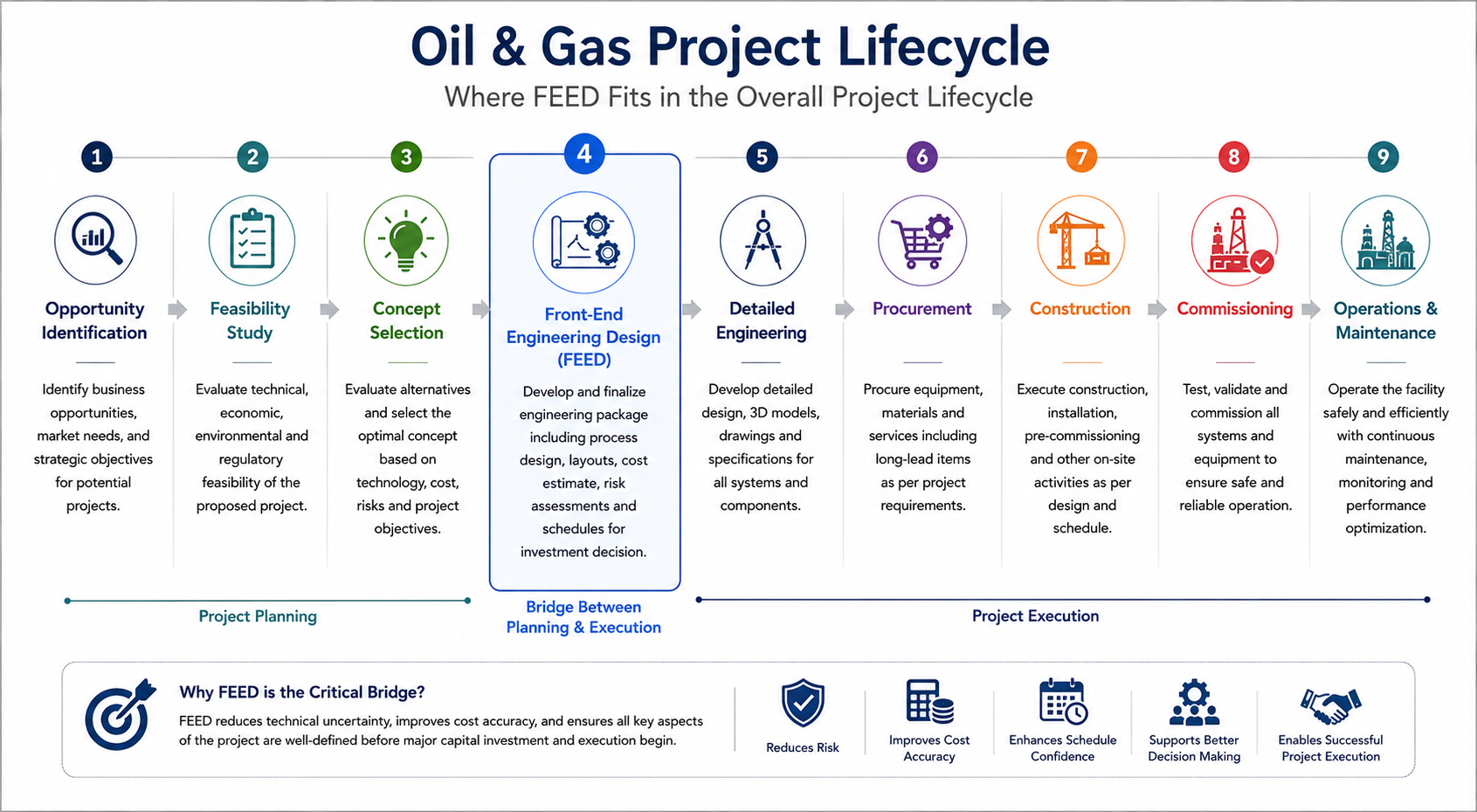
Oil & gas projects progress through a structured lifecycle to ensure technical feasibility, commercial viability, regulatory compliance, and safe execution. Each phase builds upon the outcomes of the previous stage, with the Front-End Engineering Design (FEED) phase serving as the critical bridge between planning and execution.
- Opportunity Identification: Every oil & gas project begins with identifying a business opportunity or operational need. This could involve developing a new oil or gas field, expanding an existing refinery, constructing a pipeline, increasing processing capacity, or modernizing aging infrastructure. At this stage, organizations evaluate market demand, production targets, regulatory requirements, and strategic objectives to determine whether the project should move forward.
- Feasibility Study: Once an opportunity is identified, a feasibility study evaluates whether the proposed oil & gas development, such as an offshore platform, refinery expansion, LNG terminal, gas processing plant, or cross-country pipeline is technically, economically, and environmentally viable. Engineering teams assess process requirements, estimate CAPEX and OPEX, evaluate site conditions, identify project risks, and analyze regulatory and environmental constraints to determine whether the project should proceed to the next stage.
- Concept Selection: During the concept selection phase, multiple engineering and technology options are evaluated to identify the most suitable solution for the oil & gas facility. Alternatives may include different process technologies, refinery process units, LNG liquefaction technologies, pipeline routing options, offshore facility configurations, equipment selection, and plant layouts. The preferred concept is selected based on process efficiency, safety, constructability, lifecycle costs, environmental impact, and long-term operational reliability.
- Front-End Engineering Design (FEED): The FEED phase transforms the selected concept into an execution-ready engineering package for oil & gas projects, supporting investment approval and EPC tendering. During this stage, multidisciplinary teams develop Process Flow Diagrams (PFDs), Piping & Instrumentation Diagrams (P&IDs), equipment datasheets, plot plans, piping layouts, utility philosophies, preliminary 3D models, cost estimates, project schedules, and risk assessments for facilities such as refineries, LNG terminals, gas processing plants, offshore platforms, and pipeline systems. A comprehensive FEED package reduces technical uncertainty and establishes a strong foundation for detailed engineering and project execution.
- Detailed Engineering: Following project approval, detailed engineering develops the construction-ready documentation required to build oil & gas process facilities. Engineers produce intelligent 3D plant models, piping isometrics, equipment fabrication drawings, structural steel drawings, cable schedules, instrumentation loop diagrams, and material take-offs for process units, tank farms, compressor stations, offshore modules, and pipeline infrastructure. This phase ensures every system is fully defined for procurement, fabrication, and construction.
- Procurement: The procurement phase involves sourcing equipment, materials, and specialized services required for the project. Long-lead equipment such as pressure vessels, compressors, pumps, heat exchangers, valves, and electrical systems are ordered based on the engineering specifications prepared during FEED and detailed engineering. Procurement teams also manage vendor evaluations, technical bid assessments, quality inspections, and logistics planning.
- Construction: During construction, the engineering design is transformed into operational oil & gas infrastructure, including refineries, LNG facilities, offshore platforms, gas processing plants, storage terminals, and pipeline networks. Activities include civil works, structural steel erection, equipment installation, piping fabrication and erection, electrical and instrumentation installation, hydrotesting, and utility integration. Close coordination between engineering, procurement, and construction teams ensures safe execution, quality compliance, and adherence to project schedules.
- Commissioning: Commissioning verifies that all oil & gas process systems, rotating equipment, pipelines, instrumentation, control systems, and safety systems perform as designed before commercial operation begins. Activities include flushing, hydrotesting, leak testing, equipment calibration, loop checks, functional testing, control system validation, emergency shutdown (ESD) testing, and performance verification. Successful commissioning ensures the facility is safe, compliant, and ready for reliable hydrocarbon production or processing.
- Operations & Maintenance: Once commissioned, the facility enters the operations and maintenance phase, where operators focus on maximizing the performance of oil & gas assets such as refineries, LNG terminals, offshore production facilities, pipelines, compressor stations, and gas processing plants. Routine inspections, predictive maintenance, asset integrity management, turnaround planning, and reliability improvements help maintain production efficiency while ensuring compliance with safety and environmental regulations. Operational insights gathered during this phase often drive future debottlenecking, brownfield expansion, and facility modernization initiatives.
Types of Oil & Gas Projects That Require FEED
Almost every major hydrocarbon facility undergoes front end engineering design before execution.
Upstream Facilities
FEED design for upstream oil & gas projects establishes the process design, equipment configuration, utility requirements, and offshore layout needed for safe and efficient hydrocarbon production. It also supports reservoir development planning, production optimization, and compliance with offshore safety regulations.
Typical upstream facilities covered under FEED include:
- Offshore platforms
- Wellhead processing facilities
- Central processing facilities
- Produced water treatment systems
Midstream Infrastructure
FEED engineering for midstream infrastructure focuses on optimizing pipeline routing, hydraulic analysis, pumping and compression systems, storage capacity, and terminal layouts. It helps improve transportation efficiency while ensuring asset integrity, operational reliability, and regulatory compliance.
FEED engineering is commonly applied to midstream assets such as:
- Crude oil pipelines
- Natural gas transmission pipelines
- Pumping stations
- Compressor stations
- Tank farms
Downstream Plants
Front end engineering design in downstream oil & gas facilities defines process units, utility systems, equipment sizing, plant layouts, and integration strategies before detailed engineering. It minimizes design risks, improves constructability, and supports efficient refinery and petrochemical plant operations.
Downstream projects where FEED design plays a critical role include:
- Refineries
- Petrochemical complexes
- Fuel terminals
- Blending facilities
LNG Facilities
FEED design for LNG projects addresses cryogenic process design, storage systems, loading and unloading facilities, safety systems, and utility infrastructure. It ensures reliable LNG production, storage, transportation, and regasification while meeting stringent safety and environmental requirements.
FEED scope for LNG projects typically spans:
- LNG liquefaction plants
- LNG import terminals
- LNG storage tanks
- Regasification units
Brownfield Projects
FEED engineering plays a critical role in brownfield oil & gas projects by evaluating existing facilities, identifying tie-in points, assessing constructability constraints, and minimizing operational disruptions during upgrades. It enables efficient integration of new systems with existing infrastructure while reducing project risks and shutdown durations.
Brownfield initiatives that depend on FEED include:
- Capacity expansion
- Debottlenecking
- Asset modernization
- Facility revamps
- Process optimization
Major FEED Engineering Activities in Oil & Gas Projects
Key FEED activities in the oil and gas sector involve multiple engineering disciplines working together to serve the project scope.
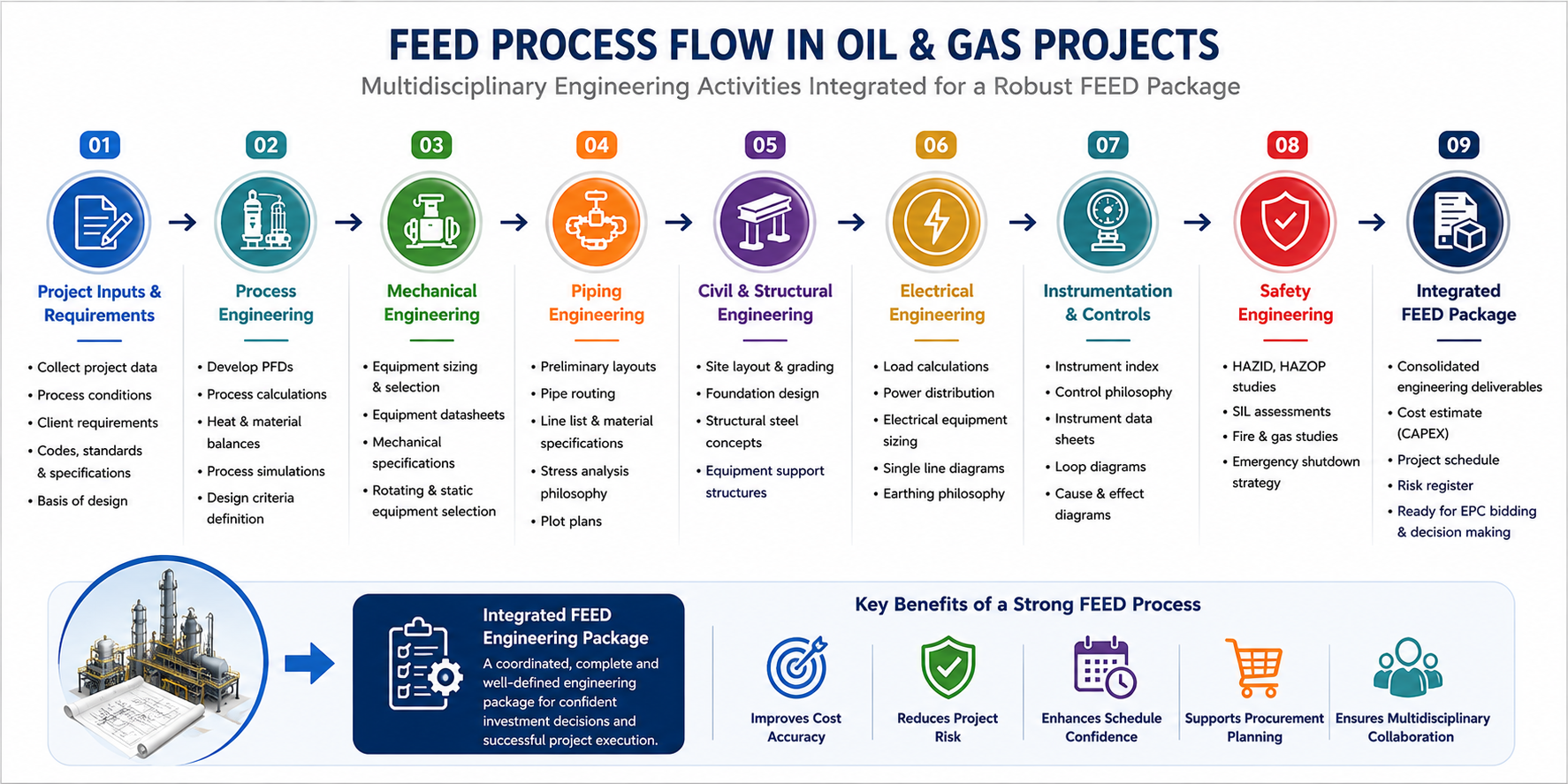
Process Engineering
- Hydrocarbon process simulation for refineries, gas processing plants, LNG facilities, and offshore production systems
- Process Flow Diagrams (PFDs) for crude oil, natural gas, LNG, and petrochemical process units
- Piping & Instrumentation Diagrams (P&IDs) for hydrocarbon processing, utility systems, and safety shutdown networks
- Heat and material balance calculations for refining, gas treating, separation, and LNG liquefaction processes
- Sizing of process equipment such as separators, columns, heat exchangers, pumps, compressors, and storage vessels
Piping Engineering
- Preliminary piping layouts for process units, pipelines, tank farms, and utility systems
- Pipeline and process piping routing philosophy for refineries, offshore platforms, and gas processing facilities
- Material specifications for hydrocarbon, corrosive, sour gas, cryogenic, and high-temperature service
- Piping stress design philosophy for high-pressure, high-temperature, cryogenic, and long-distance pipeline systems
- Plot plan development for refineries, LNG terminals, compressor stations, and storage facilities
Equipment Engineering
- Equipment specifications for pressure vessels, separators, storage tanks, heat exchangers, fired heaters, and reactors
- Pressure vessel design basis in accordance with ASME and API standards for oil & gas applications
- Selection of rotating equipment including compressors, pumps, gas turbines, and blowers
- Sizing of static equipment such as knock-out drums, scrubbers, separators, filters, and storage vessels
Civil & Structural Engineering
- Site grading and drainage design for refineries, LNG terminals, and oil & gas processing facilities
- Foundation design concepts for heavy rotating equipment, storage tanks, process units, and offshore modules
- Structural steel layouts for process structures, pipe racks, compressor buildings, and platform modules
- Equipment support structures for pressure vessels, piping systems, air coolers, and pipe bridges
Electrical Engineering
- Electrical load calculations for process plants, compressor stations, LNG terminals, and offshore facilities
- Single Line Diagrams (SLDs) for power generation and distribution networks within oil & gas facilities
- Power distribution philosophy for hazardous area installations, substations, MCCs, and emergency power systems
- Electrical equipment sizing for transformers, switchgear, UPS systems, generators, motors, and cable networks
Instrumentation & Control Engineering
- Instrument index development for process measurement and control devices across hydrocarbon facilities
- Control philosophy development for refinery units, LNG plants, gas processing facilities, and pipeline operations
- Cause & Effect diagrams for process shutdown, emergency response, and equipment protection systems
- Safety Instrumented Systems (SIS) and control architecture for critical hydrocarbon processing operations
Safety Engineering
- HAZID studies to identify process hazards associated with hydrocarbon production and processing
- HAZOP studies for refineries, gas processing plants, LNG terminals, and pipeline facilities
- SIL assessment for Safety Instrumented Functions (SIFs) in critical process systems
- Fire and Gas Detection (F&G) philosophy for hazardous areas, tank farms, offshore platforms, and process units
- Emergency Shutdown (ESD) philosophy for safe isolation and protection of oil & gas facilities during abnormal operating conditions
Key FEED Deliverables for Oil & Gas Facilities
Typical FEED engineering in oil & gas projects generates documentation required for investment approvals and EPC tendering.
| Engineering Area | Typical FEED Deliverables for Oil & Gas Projects |
| Process Engineering | Hydrocarbon Process Flow Diagrams (PFDs), Piping & Instrumentation Diagrams (P&IDs), Heat & Material Balances, Utility Flow Diagrams, Process Design Basis |
| Equipment Engineering | Equipment Datasheets for Separators, Pressure Vessels, Heat Exchangers, Pumps & Compressors, Mechanical Equipment List, Equipment Specifications |
| Piping Engineering | Plot Plans, General Arrangement (GA) Drawings, Preliminary Piping Layouts, Piping Material Specifications (PMS), Line List, Pipe Routing Philosophy |
| Civil Engineering | Refinery/LNG/Pipeline Site Development Plans, Site Grading & Drainage Plans, Foundation Design Basis, Road & Underground Utility Layouts |
| Structural Engineering | Structural Design Basis, Pipe Rack & Equipment Support Concepts, Preliminary Structural Steel Models, Offshore Module Support Layouts |
| Electrical Engineering | Electrical Load List, Single Line Diagrams (SLDs), Hazardous Area Classification, Power Distribution Philosophy, Preliminary Cable Routing |
| Instrumentation & Control Engineering | Instrument Index, Control Philosophy, Cause & Effect Matrix, I/O List, Safety Instrumented System (SIS) Philosophy, Instrument Datasheets |
| Process Safety/HAZOP | HAZID, HAZOP Studies, SIL Assessment, Safety Requirement Specification (SRS), Fire & Gas (F&G) Detection Philosophy, Emergency Shutdown (ESD) Philosophy, Hazardous Area Classification, Quantitative Risk Assessment (QRA) |
| Project Engineering | CAPEX Estimate, EPC Execution Strategy, Project Execution Schedule, Procurement Plan for Long-Lead Equipment, Risk Register, FEED Design Basis Report |
Common Challenges During the FEED Phase of Oil & Gas Projects
Despite its importance, executing FEED design in oil and gas presents several technical and commercial challenges.
- Feedstock and Process Variability: Changes in crude oil quality, natural gas composition, reservoir characteristics, or production capacity can significantly impact process design, equipment sizing, and utility requirements. FEED teams must evaluate these variations early to minimize engineering changes during detailed design.
- Brownfield Integration Challenges: Expansions and revamps of refineries, gas processing plants, LNG terminals, and offshore facilities often involve undocumented modifications, limited space, live process units, and complex tie-ins. Accurate site surveys and laser scanning are essential to reduce engineering risks and construction disruptions.
- Multi-Stakeholder Coordination: Oil & gas FEED projects require close collaboration between asset owners, process licensors, EPC contractors, technology providers, equipment vendors, regulatory authorities, and multidisciplinary engineering teams. Aligning technical requirements and project objectives across stakeholders is critical to avoid scope changes and approval delays.
- Balancing CAPEX, OPEX, and Asset Reliability: Selecting the right process technology, equipment configuration, and material specifications requires balancing capital investment with lifecycle operating costs, maintainability, energy efficiency, and long-term asset reliability. FEED studies evaluate multiple design alternatives to achieve the optimum project outcome.
- Compliance with Industry Codes and Regulatory Requirements: Oil & gas facilities must comply with industry standards such as API, ASME, ISO, IEC, NFPA, and project-specific regulations governing pressure equipment, hazardous area classification, process safety, environmental protection, and occupational health. Addressing compliance during FEED phase helps streamline approvals and reduces redesign later in the project.
- Managing Aggressive EPC and FID Schedules: Tight project timelines driven by Final Investment Decision (FID) milestones, EPC tendering schedules, and market demands can compress FEED activities and engineering reviews. Effective planning, interdisciplinary coordination, and timely stakeholder approvals are essential to maintain design quality while meeting project delivery deadlines.
How Rishabh Pro Engineering Supports Oil & Gas Companies Across FEED Phase
Rishabh Pro Engineering team delivers multidisciplinary Front End Engineering Design Services that help oil & gas companies transform project concepts into execution-ready engineering packages. Leveraging expertise across process, piping, equipment, structural, electrical, and instrumentation and control engineering, we develop accurate, standards-compliant FEED deliverables that reduce project risk, improve cost certainty, and support successful EPC execution. Our FEED capabilities are further strengthened by specialized pipeline engineering services and intelligent 3D CAD modeling, enabling optimized plant layouts, pipeline routing, clash detection, and enhanced constructability planning.
Real Life Case Study
FEED & Detailed Engineering for a Lean Gas Pipeline Project
Client
A leading European cement manufacturer planned to utilize lean natural gas as an alternative fuel source by constructing a 4 km, 8-inch gas pipeline connecting a pressure regulating and metering (PRMS) facility to a new gas distribution station in West Africa. The project required detailed engineering for gas pipeline, that included Front-End Engineering Design (FEED) to establish the engineering basis, define project scope, estimate costs, and prepare multidisciplinary engineering deliverables for EPC execution.
Project Scope
- FEED engineering and design basis development
- Process engineering (PFDs, P&IDs, process calculations)
- Pipeline engineering and route profile development
- Civil & structural engineering
- Electrical engineering
- Instrumentation & control engineering
- Procurement support
- Constructability review and HAZOP participation
Engineering Highlights
- Established the FEED design basis, project scope, cost estimates, and execution strategy for the lean gas pipeline.
- Developed Process Flow Diagrams (PFDs), Piping & Instrumentation Diagrams (P&IDs), equipment lists, and process data sheets.
- Prepared pipeline profiles, mechanical design reports, cathodic protection philosophy, and road/river crossing engineering.
- Developed electrical layouts, grounding philosophy, cable routing, and instrumentation architecture for the pipeline network.
- Supported HAZOP studies, constructability reviews, and firefighting provisions to enhance process safety and EPC readiness.
- Provided procurement support through technical specifications, RFQ documentation, and vendor engineering coordination.
Business Outcomes
- Established a robust FEED package for seamless transition into detailed engineering and EPC execution.
- Improved project planning through well-defined scope, engineering basis, and cost estimates.
- Reduced engineering risks by identifying constructability and safety considerations early in the project lifecycle.
- Enhanced procurement readiness with complete technical documentation and vendor support.
- Enabled reliable and cost-effective natural gas transportation while supporting the client’s sustainability objectives.
Concluding Thoughts
As oil and gas facilities become more complex, project owners require greater certainty before committing significant capital investments. A robust front end engineering design establishes the technical, commercial, and operational framework necessary for successful oil & gas project execution. From offshore platforms and LNG terminals to refineries, pipelines, and gas processing facilities, comprehensive FEED engineering reduces project risk, improves cost predictability, and strengthens multidisciplinary coordination. Organizations that invest in high-quality oil & gas engineering services are better positioned to achieve safer construction, optimized operations, and long-term asset performance.
Frequently Asked Questions On FEED In Oil and Gas Industry
Q: How long does the FEED phase typically take for an oil & gas project?
A: The duration of the FEED phase depends on the project’s size, complexity, and scope. Smaller brownfield modifications may require 2–4 months, while large greenfield developments such as LNG terminals, offshore platforms, or refinery expansions can take 6–12 months or longer. Factors such as regulatory approvals, stakeholder reviews, and technology selection can also influence the timeline.
Q: Who is responsible for carrying out FEED in oil & gas projects?
A: Front end engineering design is typically performed by multidisciplinary engineering consultants or EPC (Engineering, Procurement, and Construction) companies working closely with the project owner. Depending on the project, licensors, technology providers, and specialist consultants may also contribute to process design, safety studies, and equipment specifications to ensure the engineering package meets project objectives.
Q: How does digital engineering improve the FEED process in oil & gas projects?
A: Digital engineering tools such as intelligent 3D plant modeling, Building Information Modeling (BIM), laser scanning, cloud-based collaboration platforms, and engineering design software enable teams to detect clashes early, improve design coordination, and reduce engineering rework. These technologies also enhance visualization, support constructability reviews, and streamline communication among project stakeholders during the FEED phase.
Q: What international standards are commonly considered during the FEED phase of oil & gas projects?
A: FEED engineering is typically developed in accordance with internationally recognized standards based on the project type and location. Commonly referenced standards include API for petroleum equipment and systems, ASME for pressure vessels and piping, ISO standards, IEC for electrical and instrumentation systems, NFPA for fire protection, and applicable local statutory and environmental regulations.
Q: Can changes still be made after the FEED phase is completed?
A: Yes. While front end engineering and design aims to define the project scope with a high level of confidence, changes may still occur during detailed engineering or construction due to evolving operational requirements, regulatory updates, vendor information, or unforeseen site conditions. However, making significant changes after FEED is complete is generally more expensive and time-consuming, which is why a thorough FEED process is essential to minimize late-stage revisions.