Data centers are no longer designed around a simple assumption of evenly distributed IT loads and conventional air conditioning. The rapid growth of cloud computing, AI, high-performance computing (HPC), and accelerated computing is increasing rack power densities and changing the way heat must be managed.
As computational loads increase, cooling is becoming a critical engineering discipline rather than a supporting facility function. A well-designed data center cooling system must maintain equipment within acceptable operating conditions while balancing energy efficiency, reliability, maintainability, space constraints, and future scalability.
This makes data center cooling system design a multidisciplinary engineering challenge. Engineers must consider thermal loads, airflow, equipment layouts, mechanical systems, electrical interfaces, redundancy requirements, environmental conditions, and operational scenarios before selecting and sizing cooling infrastructure.
The next generation of data centers will require cooling architectures that can respond to changing workloads, not simply remove today’s heat load.
In this data center cooling system design guide, we’ll explore its key aspects, including design considerations, applicable standards and guidelines, key design steps, cooling system types and components, modeling and simulation, redundancy and efficiency, common design challenges and how to address them, and essential engineering deliverables. We’ll also look at how the Rishabh Pro Engineering team can support data center cooling projects through a multidisciplinary engineering approach.
What Is Data Center Cooling System Design?
Data center cooling system design is the engineering process of developing systems that remove heat generated by IT equipment and maintain suitable temperature, humidity, and environmental conditions throughout a data center.
At a fundamental level, the cooling system must:
- Remove heat generated by servers, networking equipment, and supporting infrastructure.
- Maintain acceptable temperature and humidity conditions.
- Manage airflow effectively across IT equipment.
- Prevent localized hotspots.
- Support equipment reliability and availability.
- Provide adequate redundancy for critical loads.
- Operate efficiently across different load conditions.
- Allow capacity expansion as IT requirements increase.
Traditional facilities often rely heavily on computer room air conditioning (CRAC) or computer room air handling (CRAH) units. However, higher-density computing is driving the adoption of technologies such as in-row cooling, rear-door heat exchangers, direct-to-chip liquid cooling, and other hybrid cooling architectures.
Therefore, modern data center cooling design must begin with the expected thermal profile and operational requirements rather than simply selecting cooling equipment based on total building load.
Data Center Cooling Design Considerations
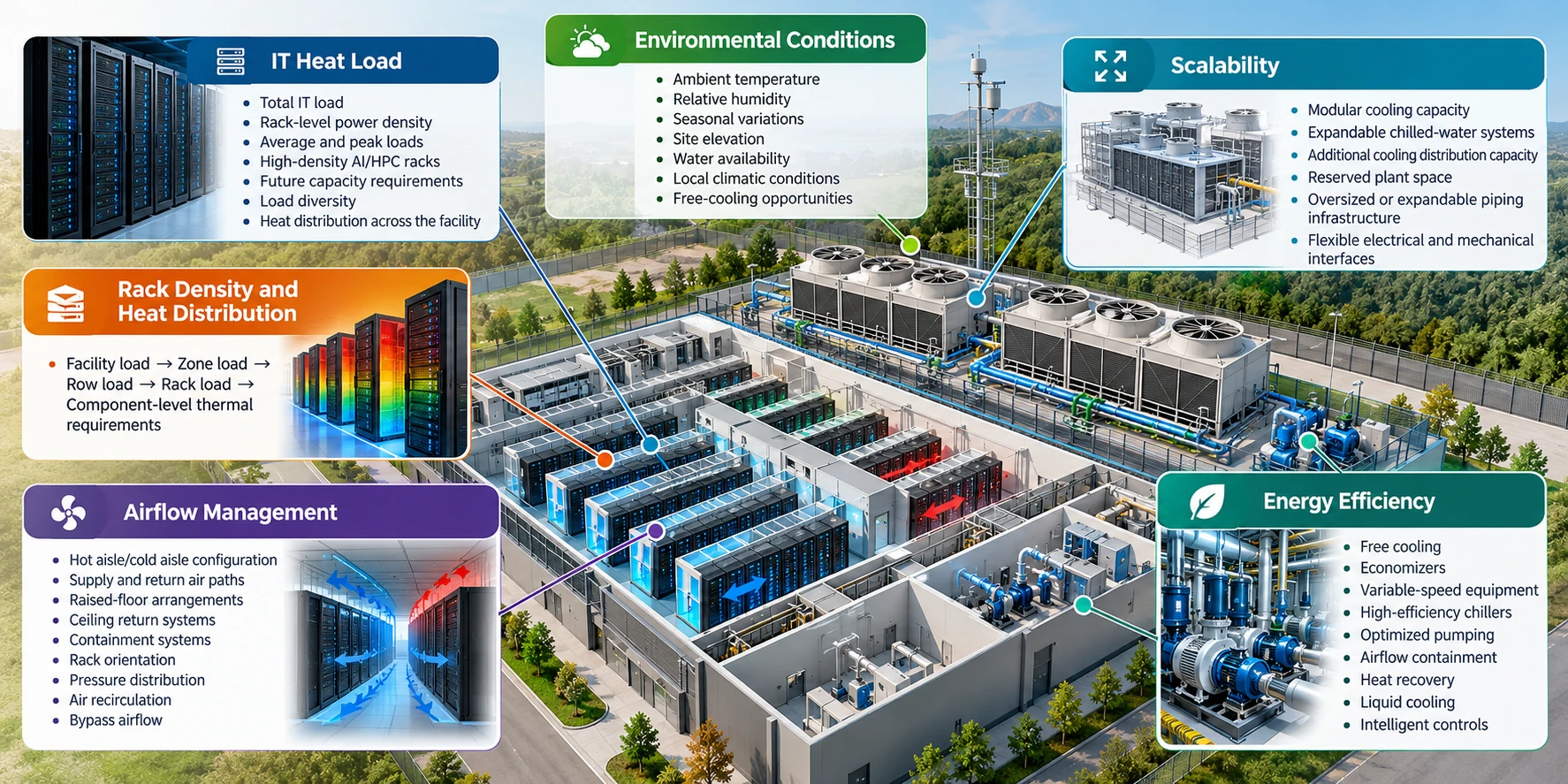
A robust cooling strategy begins with understanding the conditions under which the data center will operate.
IT Heat Load
Nearly all electrical power consumed by IT equipment ultimately becomes heat. Therefore, understanding current and projected IT loads is fundamental to cooling design.
Engineers should evaluate:
- Total IT load
- Rack-level power density
- Average and peak loads
- High-density AI/HPC racks
- Future capacity requirements
- Load diversity
- Heat distribution across the facility
A data center with a predominantly low-density rack population may have very different cooling requirements from an AI facility with extremely high-density racks.
Rack Density and Heat Distribution
Average facility load can hide localized thermal challenges. For example, a facility may have adequate overall cooling capacity while individual high-density racks experience unacceptable temperatures.
Cooling design therefore needs to consider:
Facility load → Zone load → Row load → Rack load → Component-level thermal requirements
This is particularly important when designing facilities for GPU-intensive computing.
Airflow Management
Poor airflow management can increase cooling energy consumption and create hot spots.
Effective design considers:
- Hot aisle/cold aisle configuration
- Supply and return air paths
- Raised-floor arrangements
- Ceiling return systems
- Containment systems
- Rack orientation
- Pressure distribution
- Air recirculation
- Bypass airflow
The objective is not simply to move more air, but to deliver the right quantity of conditioned air to the right location.
Environmental Conditions
Outdoor design conditions influence equipment selection and cooling capacity.
Engineers should evaluate:
- Ambient temperature
- Relative humidity
- Seasonal variations
- Site elevation
- Water availability
- Local climatic conditions
- Free-cooling opportunities
Scalability
Cooling infrastructure should support future IT growth without requiring major modifications to the facility.
This may involve:
- Modular cooling capacity
- Expandable chilled-water systems
- Additional cooling distribution capacity
- Reserved plant space
- Oversized or expandable piping infrastructure
- Flexible electrical and mechanical interfaces
Energy Efficiency
Cooling can represent a significant portion of a data center’s energy consumption.
Therefore, data center cooling design should evaluate opportunities for:
- Free cooling
- Economizers
- Variable-speed equipment
- High-efficiency chillers
- Optimized pumping
- Airflow containment
- Heat recovery
- Liquid cooling
- Intelligent controls
The objective is to achieve the required thermal performance with the lowest practical energy consumption.
Standards and Guidelines for Data Center Cooling Design
Data center cooling systems must be designed around applicable industry standards, project specifications, equipment requirements, and local regulations.
Depending on project location and scope, engineers may reference standards and guidelines such as:
- ASHRAE TC 9.9 – Thermal Guidelines for Data Processing Environments
- ASHRAE Standard 90.4 – Energy Standard for Data Centers
- ANSI/TIA-942 – Telecommunications Infrastructure Standard for Data Centers
- Uptime Institute guidance for data center resilience and availability
- Applicable mechanical, electrical, fire protection, plumbing, and building codes
- Local environmental and energy regulations
- Client-specific design standards and specifications
These standards should not be treated as isolated compliance requirements. Their requirements need to be translated into actual engineering decisions involving equipment selection, redundancy, operating temperatures, airflow, controls, and system architecture.
Data Center Cooling System Design: Key Steps
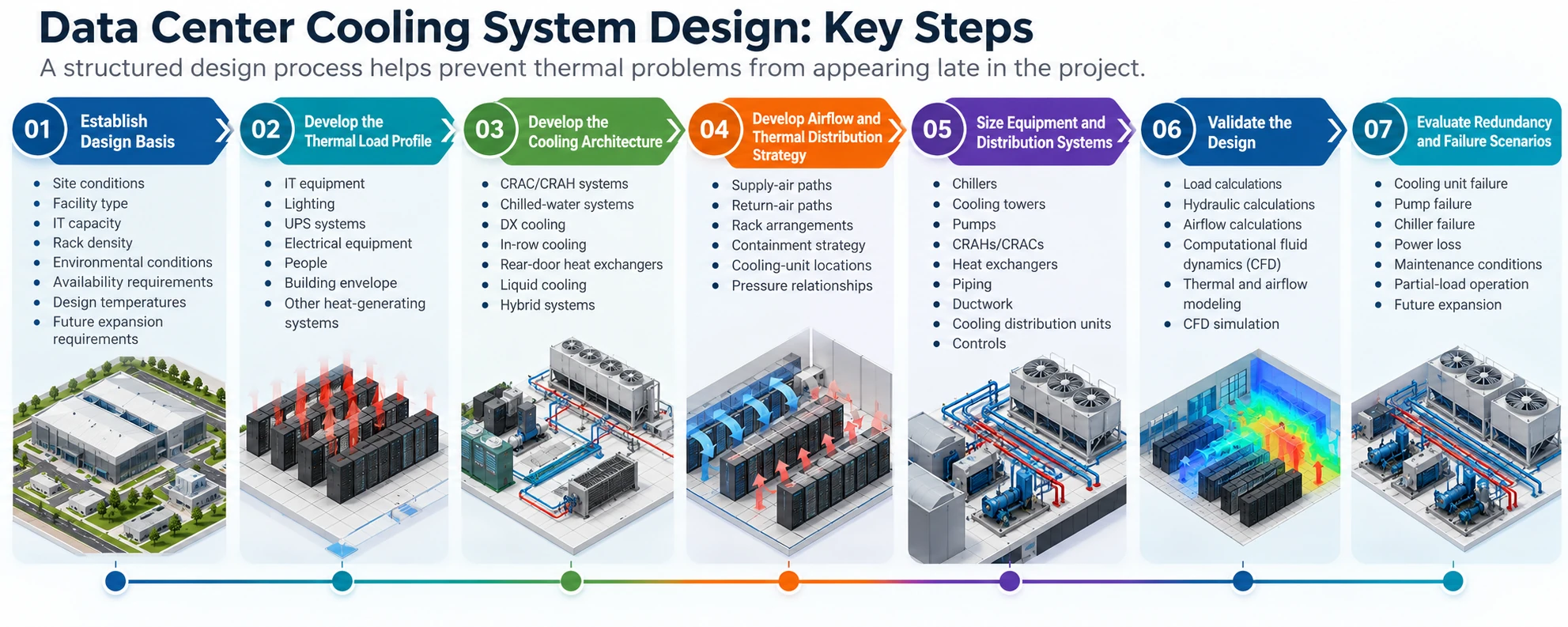
A structured design process helps prevent thermal problems from appearing late in the project.
Step 1: Establish Design Basis
Define:
- Site conditions
- Facility type
- IT capacity
- Rack density
- Environmental conditions
- Availability requirements
- Design temperatures
- Future expansion requirements
Step 2: Develop the Thermal Load Profile
Calculate heat loads for:
- IT equipment
- Lighting
- UPS systems
- Electrical equipment
- People
- Building envelope
- Other heat-generating systems
The load profile should consider both present and future operating scenarios.
Step 3: Develop the Cooling Architecture
Depending on the facility requirements, engineers may evaluate:
- CRAC/CRAH systems
- Chilled-water systems
- DX cooling
- In-row cooling
- Rear-door heat exchangers
- Liquid cooling
- Hybrid systems
Step 4: Develop Airflow and Thermal Distribution Strategy
The design should establish:
- Supply-air paths
- Return-air paths
- Rack arrangements
- Containment strategy
- Cooling-unit locations
- Pressure relationships
Step 5: Size Equipment and Distribution Systems
Equipment and associated infrastructure are sized based on calculated thermal loads and operating scenarios.
This includes:
- Chillers
- Cooling towers
- Pumps
- CRAHs/CRACs
- Heat exchangers
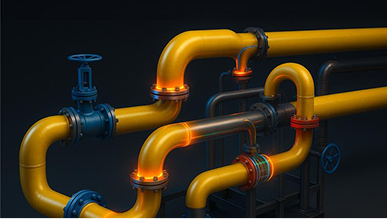
- Piping
- Ductwork
- Cooling distribution units
- Controls
Step 6: Validate the Design
Engineering validation can involve:
- Load calculations
- Hydraulic calculations
- Airflow calculations
- Computational fluid dynamics (CFD)
- Thermal and Airflow Modeling
- CFD simulation
Step 7: Evaluate Redundancy and Failure Scenarios
The system should be assessed under scenarios such as:
- Cooling unit failure
- Pump failure
- Chiller failure
- Power loss
- Maintenance conditions
- Partial-load operation
- Future expansion
Types of Data Center Cooling Systems and Components
There is no single cooling architecture suitable for every data center. The appropriate solution depends on rack density, climate, facility scale, availability requirements, and operational strategy.
Air-Cooled Systems
Conventional air-based cooling typically uses CRAC or CRAH units to circulate conditioned air through the IT environment. These systems remain effective for many conventional rack-density applications.
Chilled-Water Cooling
Central chilled-water systems can provide efficient cooling for large-scale facilities.
Typical components include:
- Chillers
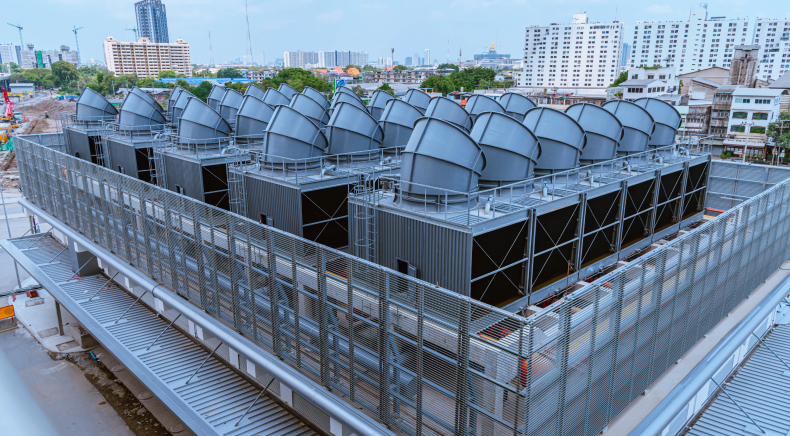
- Cooling towers or dry coolers
- Pumps
- CRAHs
- Chilled-water piping
- Heat exchangers
- Control systems
In-Row Cooling
In-row systems position cooling equipment close to high-density racks, reducing the distance air needs to travel. This can provide improved thermal control for high-density applications.
Rear-Door Heat Exchangers
Rear-door heat exchangers capture heat directly from the exhaust side of IT racks. They can be particularly useful for managing high-density racks while continuing to use air as the primary room-level cooling medium.
Direct-to-Chip Liquid Cooling
Liquid cooling transfers heat directly from high-temperature components such as CPUs and GPUs.
Depending on the architecture, systems may use:
- Cold plates
- Coolant distribution units
- Pumps
- Heat exchangers
- Supply and return piping
- Monitoring and control systems
Data Center Cooling Modeling and Simulation
Data center thermal performance can be evaluated at different levels of engineering detail. System-level thermal modeling is typically used during early design to assess overall cooling capacity, thermal loads, equipment performance, and operating scenarios. It helps engineers compare cooling architectures and understand how the system is expected to respond to changes in load or operating conditions.
Computational Fluid Dynamics (CFD) provides a more detailed assessment of airflow and temperature distribution within the physical data center environment. It is particularly useful for evaluating rack-level thermal behavior, airflow patterns, hotspots, recirculation, containment strategies, and the impact of equipment or layout changes.
The two approaches are complementary: system-level modeling helps establish and validate the overall cooling strategy, while CFD modeling and simulation helps resolve detailed thermal and airflow behavior within the facility. Selecting the appropriate level of analysis depends on the project stage, rack density, cooling architecture, and specific engineering questions being evaluated.
Physical intuition alone is often insufficient for complex data center environments. Data center cooling modeling enables engineers to represent the thermal and airflow behavior of a facility before construction or modification.
What Data Center Cooling Modeling Can Evaluate
Data center cooling modeling can be used to assess:
- Airflow distribution
- Temperature distribution
- Pressure zones
- Rack-level temperatures
- Cooling-unit performance
- Hotspot formation
- Air recirculation
- Containment effectiveness
- Equipment failure scenarios
- Future load and capacity conditions
Data Center Cooling Simulation
Data center cooling simulation can be particularly valuable for large facilities or high-density environments where small design changes can have significant thermal consequences.
CFD-based analysis can help engineers answer questions such as:
- Are cooling units correctly positioned?
- Is conditioned air reaching high-density racks?
- Are hotspots developing?
- Is hot-air recirculation occurring?
- What happens if a cooling unit fails?
- Does containment improve thermal performance?
- Can cooling capacity be reduced without compromising equipment conditions?
The value of simulation is therefore not simply visualization. It is the ability to test engineering decisions before they become expensive physical changes.
Designing a Data Center Cooling System for Redundancy and Efficiency
Availability and efficiency must be considered together. A highly redundant system can provide resilience, but excessive installed capacity may increase capital cost and reduce operating efficiency. The engineering challenge is to determine the appropriate balance.
Cooling Redundancy
Depending on the required availability level, cooling systems may incorporate configurations such as:
- N
- N+1
- 2N
- 2N+1
Redundancy should be evaluated across the complete cooling chain rather than only at equipment level.
For example:
Chiller → Pump → Heat Exchanger → Distribution → CRAH/CDU → Rack
A redundant chiller does not provide meaningful resilience if a common downstream component can still become a single point of failure.
Concurrent Maintainability
A well-designed data center cooling system should allow planned maintenance, inspection, testing, or replacement of individual cooling components without interrupting critical IT operations. This requires redundancy to be considered not only for equipment capacity but also for distribution paths, controls, isolation arrangements, and supporting utilities.
During design, engineers should evaluate maintenance scenarios such as:
- Taking a chiller, CRAH, pump, or cooling distribution unit offline
- Isolating sections of chilled-water or cooling-water piping
- Performing equipment maintenance without affecting critical loads
- Maintaining adequate cooling capacity during planned shutdowns
- Providing safe access and clearance around maintainable equipment
Concurrent maintainability should be incorporated from the early design stage so that maintenance requirements do not compromise cooling availability or operational resilience. This is particularly important for facilities operating continuously or supporting high-density and mission-critical computing workloads.
The strongest design is therefore not necessarily the system with the largest cooling capacity; it is the system that provides the required resilience while operating efficiently across realistic load conditions.
PUE and Cooling Efficiency
Cooling efficiency can be improved through:
- Variable-speed drives
- Temperature setpoint optimization
- Free cooling
- Economization
- Efficient chillers
- Pump optimization
- Airflow containment
- Higher allowable operating temperatures within applicable guidelines
- Liquid cooling for high-density loads
PUE measures the total energy consumed by a data center relative to the energy delivered to IT equipment. Since cooling can represent a significant portion of facility energy consumption, optimizing the cooling system can directly contribute to achieving a lower and more efficient PUE.
Common Cooling Design Challenges and How to Address Them
Designing a reliable and efficient data center cooling system involves more than calculating the required cooling capacity. Increasing rack densities, evolving cooling technologies, operational constraints, and the need for continuous availability can introduce significant engineering challenges. Addressing these challenges early in the design process helps improve system reliability, efficiency, maintainability, and scalability.
Challenge 1: Rapidly Increasing Rack Density
The growing adoption of AI, GPU-intensive computing, and high-performance workloads is driving significantly higher rack power densities. Conventional room-level cooling systems may not be sufficient to manage these concentrated thermal loads.
How to Address It: Identify high-density zones during the early design stages and evaluate appropriate cooling strategies, including in-row cooling, rear-door heat exchangers, direct-to-chip liquid cooling, or hybrid cooling architectures. Designing cooling infrastructure with provisions for future rack-density increases can also improve long-term scalability.
Challenge 2: Localized Hotspots Despite Adequate Cooling Capacity
A data center may have sufficient overall cooling capacity and still experience localized hotspots due to poor airflow distribution, rack arrangement, bypass airflow, or hot-air recirculation.
How to Address It: Evaluate rack layouts, supply and return airflow paths, containment strategies, pressure distribution, and cooling-unit placement. Data center cooling modeling and simulation, including CFD analysis where appropriate, can help identify thermal issues and validate the effectiveness of proposed design changes before implementation.
Challenge 3: Oversized Cooling Infrastructure
Designing exclusively for maximum or worst-case loads can result in excessive cooling capacity, higher capital costs, inefficient part-load operation, and underutilized equipment.
How to Address It: Develop realistic load profiles that consider current demand, load diversity, peak conditions, operating scenarios, and future expansion. Modular cooling systems, variable-speed equipment, and scalable infrastructure can help align installed capacity with actual and projected requirements.
Challenge 4: Maintaining Cooling Resilience During Maintenance
A cooling system may appear adequately redundant during normal operation but lose its resilience when equipment is taken offline for planned maintenance. Common dependencies between chillers, pumps, distribution systems, controls, and cooling units can create hidden single points of failure.
How to Address It: Evaluate redundancy and maintainability across the complete cooling chain. Maintenance scenarios, equipment failure modes, and isolation requirements should be assessed during the design stage to ensure that critical cooling loads remain supported when equipment is unavailable.
Challenge 5: Integrating Liquid Cooling
Liquid cooling can provide an effective solution for high-density computing but introduces additional engineering requirements, including coolant distribution, piping, pumping, heat exchange, leak detection, controls, and equipment interfaces.
How to Address It: Treat liquid cooling as an integrated mechanical engineering system rather than simply an IT equipment interface. The design should address the complete cooling loop, including coolant distribution units, piping networks, heat exchangers, pumps, controls, monitoring, leak detection, and integration with the facility’s primary cooling infrastructure.
Challenge 6: Upgrading Existing Data Centers
Brownfield data center upgrades are often more complex than new-build projects because the cooling design must work within existing physical and operational constraints. These may include existing piping and ductwork, limited plant space, structural capacity, electrical infrastructure, established airflow paths, and restrictions on equipment shutdowns.
How to Address It: Begin with a detailed assessment of the existing facility, supported by accurate engineering documentation, site surveys, 3D modeling, and where required, laser scanning or point cloud data. The proposed cooling modifications should then be evaluated against existing mechanical, structural, electrical, and operational interfaces to minimize disruption while enabling the required capacity and performance improvements.
Ultimately, effective data center cooling design requires engineers to look beyond equipment capacity and consider how the system will perform under normal operation, peak loads, equipment failure, maintenance conditions, and future expansion.
Data Center Cooling System Design Deliverables
A well-engineered data center cooling system requires a coordinated set of calculations, drawings, specifications, models, and technical documentation. The exact deliverables vary depending on project scope, cooling architecture, facility capacity, and the level of engineering required, from concept and FEED through detailed engineering and construction support.
Typical data center cooling system design deliverables may include:
Design Basis and Engineering Calculations
- Design Basis / Design Criteria
- Cooling Load Calculations
- Thermal Load Assessment
- Equipment Sizing and Selection Calculations
- Hydraulic and Airflow Calculations
- Energy Performance Assessments, where applicable
Cooling System and Equipment Documentation
- HVAC System Design
- Cooling System Schematics
- Cooling Equipment Datasheets
- Equipment Schedules
- Technical Specifications
- Control Philosophy
- Equipment Selection and Technical Evaluation Documentation
Layout and Piping Deliverables
- HVAC Layouts
- Chilled-Water / Cooling-Water Piping Layouts
- Equipment Arrangement Drawings
- Ducting Layouts
- Piping and Instrumentation Diagrams (P&IDs)
- Piping Isometric Drawings
- Piping Support and Interface Details, where applicable
Modeling, Analysis, and Validation
- 3D Cooling System Models
- Thermal and Airflow Model
- CFD / Thermal Analysis Reports
- Airflow Distribution Studies
- Thermal Performance Validation
- Clash Detection and Interdisciplinary Coordination Reports
Quantity and Project Documentation
- Material Take-Offs (MTO)
- Bill of Quantities (BOQ)
- Equipment and Material Specifications
- Engineering Design Reports
- Vendor Data Review Documentation
- Equipment and Utility Interface Documentation
Multidisciplinary Coordination
Data center cooling systems are closely integrated with the wider facility infrastructure. Consequently, cooling engineering deliverables need to be coordinated with mechanical, piping, structural, electrical, instrumentation and controls, architectural, fire protection, and other relevant disciplines. This coordination is particularly important for equipment access, pipe routing, structural loads, electrical interfaces, maintenance clearances, fire protection requirements, and space allocation.
A coordinated deliverable package ensures that the cooling system is not only thermally adequate but also constructible, maintainable, spatially coordinated, and ready for integration with the overall data center infrastructure.
How Rishabh Pro Engineering Approaches Data Center Cooling Design
At Rishabh Pro Engineering, we approach data center cooling as an integrated engineering challenge, one that extends beyond HVAC equipment selection. With our industrial equipment engineering services, we address thermal performance, piping, equipment interfaces, spatial coordination, structural requirements, controls, and future scalability.
Our multidisciplinary engineering capabilities enable us to evaluate the cooling system within the context of the overall facility, helping ensure that thermal requirements are translated into practical, coordinated, and constructible engineering solutions.
Our approach brings together:
- Mechanical Engineering: Developing and coordinating mechanical systems around the facility’s thermal and operational requirements.
- HVAC & Cooling Systems: Designing cooling architectures, airflow strategies, equipment arrangements, and thermal management solutions.
- Piping Engineering: Developing chilled-water, cooling-water, and associated piping systems, including routing, layouts, and detailed engineering.
- Equipment Engineering: Supporting equipment selection, sizing, datasheets, specifications, and equipment interfaces.
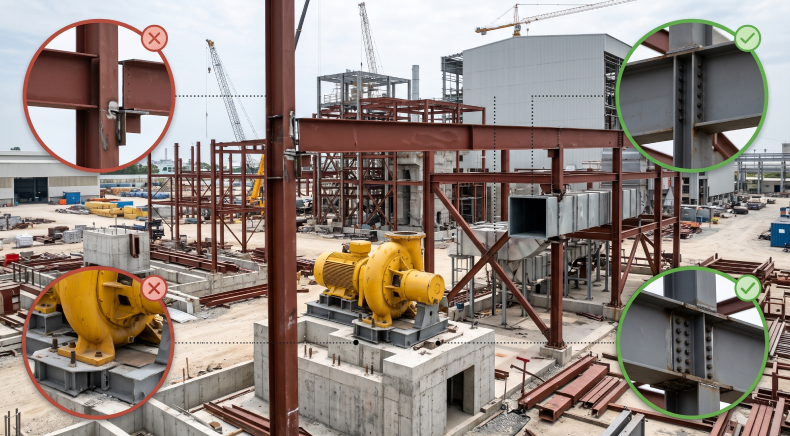
- Structural Engineering: Coordinating equipment loads, supports, penetrations, and structural interfaces.
- Electrical Engineering: Addressing interfaces between cooling equipment, power distribution, backup systems, and facility infrastructure.
- Instrumentation & Controls Engineering: Supporting monitoring, control philosophy, system integration, and operational requirements.
- 3D CAD Modeling & Coordination – Developing coordinated 3D models to optimize layouts, identify clashes, and improve constructability.
- Engineering Analysis & Validation – Applying engineering calculations, thermal assessments, modeling, and simulation to validate design decisions.
From Design Basis to Detailed Engineering
Our engineering workflow can span the complete design development cycle:
Design Basis → Thermal Load Assessment → Cooling Architecture → Equipment Selection → HVAC & Piping Design → 3D Modeling & Coordination → Cooling Modeling & Simulation → Engineering Review → Detailed Engineering
At each stage, engineering decisions are evaluated against performance, reliability, constructability, maintainability, space constraints, and future expansion requirements.
This integrated approach helps identify potential design conflicts early, before they become construction or operational challenges. It also enables the cooling system to be evaluated as part of the larger facility rather than as a standalone HVAC system.
Concluding Thoughts
The future of data center cooling is moving beyond conventional room-level air conditioning.
As rack densities increase and AI-driven workloads become more common, cooling systems will need to become more targeted, adaptive, efficient, and resilient. Air cooling will continue to play an important role, but high-density applications are accelerating interest in liquid cooling, hybrid architecture, advanced thermal modeling, and intelligent controls.
Effective data center cooling system design therefore starts much earlier than equipment selection. It begins with understanding the workload, predicting how heat will move through the facility, evaluating alternative cooling architectures, validating performance through data center cooling modeling and simulation, and designing redundancy without unnecessarily compromising efficiency.
Frequently Asked Questions
Q: Why is data center cooling design becoming more important?
A: Increasing rack densities, AI/GPU workloads, and high-performance computing are generating significantly higher localized heat loads, requiring more advanced thermal management strategies.
Q: What is data center cooling modeling?
A: Data center cooling modeling creates a digital representation of the facility’s thermal and airflow behavior to evaluate temperature distribution, airflow paths, hotspots, and cooling performance.
Q: What is data center cooling simulation?
A: Data center cooling simulation uses computational methods, often CFD, to predict how air, heat, and sometimes liquid coolant behave within the cooling system under different operating conditions.
Q: How does CFD help in data center cooling design?
A: CFD can help identify hotspots, airflow recirculation, poor cooling-unit placement, pressure imbalances, and the impact of containment or equipment-layout changes before physical implementation.
Q: Is liquid cooling replacing air cooling in data centers?
A: Not necessarily. Liquid cooling is particularly relevant for high-density workloads, while conventional air cooling remains practical for many lower-density applications. Hybrid architectures can combine both approaches.
Q: What engineering services are required for a data center cooling project?
A: Depending on project scope, services can include cooling load calculations, HVAC engineering, equipment selection, piping design, 3D modeling, CFD analysis, equipment layouts, interdisciplinary coordination, detailed engineering, and construction documentation.